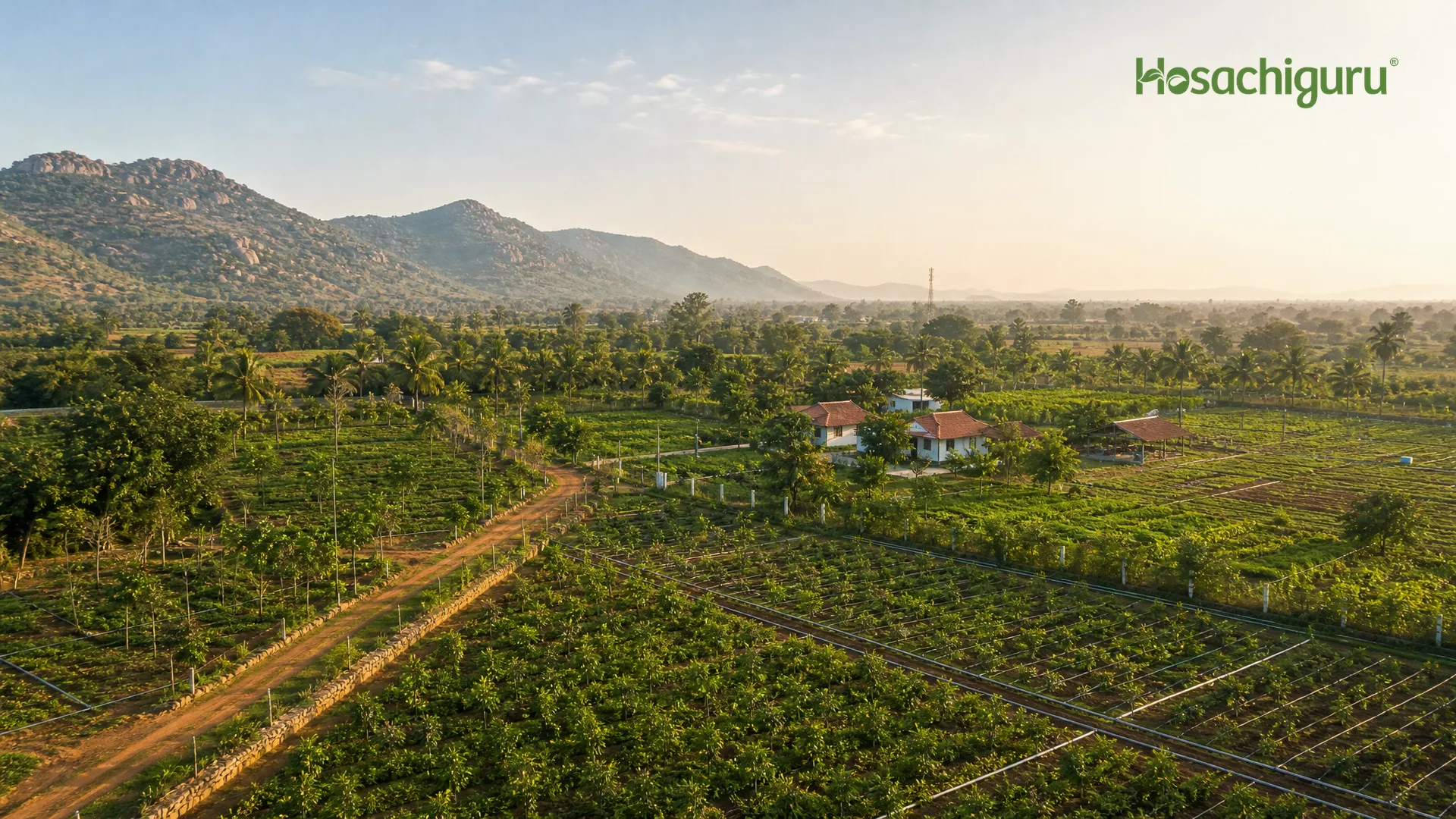
You want to own farmland near Bengaluru. You do not want to become a farmer. That gap between desire and daily reality is exactly what Hosachiguru’s managed farmland model was built to close. Understanding how titled land ownership separates from professional farm management is the single most important step before you evaluate any managed farm plot for sale.
TL;DR – Summary
- What is managed farmland? – Managed farmland is a model where you hold legal title to a farm plot while a professional team handles all agronomy, irrigation, soil care, and hospitality operations on your behalf. Hosachiguru pioneered this structure for urban Indian buyers near Bengaluru.
- Who owns the land? – You do. Hosachiguru registers the sale deed in your name, completes mutation, and hands over all ownership records. The land title stays with you, not with the management company.
- Who runs the farm? – Hosachiguru’s on ground agronomy team manages crop planning, soil health, irrigation systems, pest management, pruning cycles, and harvest timing. Owners receive updates through the MyFarm app without needing to be present.
- What about hospitality and visits? – Hosachiguru maintains cottages, clubhouse amenities, and retreat areas so owners can visit for weekends, family retreats, or harvest experiences without arranging anything themselves.
- How does reporting work? – The MyFarm app provides real time farm updates, harvest reports, water management data, payment tracking, and access to land documents, giving owners transparency without operational involvement.
Why ownership and management split
Most urban professionals in India understand buying property. They also understand, at least conceptually, what farming involves. The confusion sits in the middle: how can you legally own agricultural land yet never worry about soil testing, drip irrigation scheduling, or seasonal crop planning?
Hosachiguru addresses this by structuring two distinct layers. The first layer is legal farmland ownership, where the buyer holds a clear title, a registered sale deed, and mutation records in their name. The second layer is professional farm management, where Hosachiguru’s agronomy and hospitality teams handle every operational task on the land.
This separation means you carry the asset on your balance sheet. Hosachiguru carries the operational responsibility. Neither side crosses into the other’s domain.
How legal ownership works
When you purchase a managed farm plot through Hosachiguru, the sale deed is registered in your name under applicable state law. For plots in Karnataka, this process follows standard land registration procedures, including title verification, encumbrance certificate checks, and mutation in revenue records.
Hosachiguru’s in house legal team conducts due diligence before any plot is offered. This can help ensure clear title, verified survey records, and compliance with regulations such as the Karnataka Land Reforms Act Section 109 for non agriculturalist buyers where applicable.
After registration, you receive your sale deed, patta book entries, and ownership records. The land is yours. You can visit it, pass it to heirs, or sell it independently. Hosachiguru does not hold title or act as a co owner.
What farm management covers
Once ownership transfers, Hosachiguru’s agronomy team takes over daily operations. This is where the model diverges from traditional farmland purchases, where buyers often struggle with unfamiliar agricultural tasks.
The management scope includes soil analysis and plot specific soil reports covering pH, organic carbon content, nutrient profiles, and drainage assessments. From these reports, the team builds crop planning and tree mix strategies suited to each project’s geography, whether that is a mango orchard in Ramanagara, a food forest near Chikkaballapur, or an agroforest project near Hindupur.
Irrigation planning covers drip irrigation installation, borewell management, rainwater harvesting systems, and summer water planning. Hosachiguru’s water management approach is designed to reduce dependence on borewells through recharge systems and sustainable drainage.
Ongoing care includes pruning cycles, companion planting, mulch layer maintenance, pest management using chemical free methods, and seasonal harvest timing. The agronomy team handles all of this without requiring the owner’s presence or decisions.
Hospitality without hassle
Managed farmland is not only an agricultural asset. For many Hosachiguru co farmers, it doubles as a weekend retreat. Hosachiguru maintains hospitality infrastructure across its projects, including cottages, clubhouse facilities, outdoor dining areas, cycling paths, and community spaces.
Owners can book stays for family retreats, harvest experiences, or simple weekend getaways. Children can participate in outdoor activities, families can cook together with farm fresh produce, and the entire visit happens without the owner coordinating maintenance, security, or meal preparation.
This hospitality layer is what transforms a farm plot from a remote land parcel into a usable lifestyle asset, accessible within 45 to 90 minutes from Bengaluru depending on the project corridor.
Transparency through the MyFarm app
The final piece connecting ownership to management is reporting. Hosachiguru’s MyFarm app gives each owner a window into their plot’s operations. The app is designed to show real time farm updates, harvest reports, water management data, payment tracking, and access to land documents.
This means an owner sitting in Bengaluru or abroad can review what is happening on their plot without making a single phone call. Soil health improvements, seasonal produce updates, and upcoming agronomy activities are all visible in one place.
For a community of over 1,800 co farmers, this digital layer replaces the need for physical oversight. It is the mechanism that makes “ownership without management” practical rather than theoretical.
Who this model suits
Hosachiguru’s separation of ownership from operations is designed for urban Indian families, working professionals, and NRIs who want farmland as a lifestyle and long term asset. These buyers value legal farmland ownership, chemical free farming practices, and weekend access to nature, but they do not have the time, expertise, or desire to manage agricultural operations themselves.
The model can help suit buyers looking at managed farm plots near Bangalore across corridors like Chikkaballapur, Ramanagara, Hindupur, Bagepalli, and Denkanikottai. Plot sizes typically range from quarter acre to half acre and above, with projects offering RERA approved layouts where applicable.
If you are evaluating managed farmland, the core question is not whether you can farm. It is whether the structure gives you clear title, professional agronomy, usable hospitality, and transparent reporting. Hosachiguru’s model is built to deliver all four without requiring you to pick up a single farming tool.
FAQs
1. What is managed farmland?
Managed farmland is agricultural land where you hold legal title while a professional team handles all farming operations. Hosachiguru manages agronomy, irrigation, soil care, and hospitality so owners enjoy farmland benefits without daily farm work.
2. How does farmland ownership work in India?
Farmland ownership in India involves registering a sale deed in the buyer’s name, completing mutation in revenue records, and obtaining clear title documents. Hosachiguru’s legal team conducts due diligence and handles registration for each plot.
3. How do managed farm plots work?
Managed farm plots separate land ownership from operations. You own the titled land. Hosachiguru’s agronomy team manages soil health, irrigation, crop planning, and harvests. Owners track everything through the MyFarm app.
4. Can non agriculturalists buy managed farmland in Karnataka?
Hosachiguru’s legal team evaluates eligibility under the Karnataka Land Reforms Act Section 109 and conducts due diligence before offering plots. Buyers should consult the in house legal team or an independent lawyer for their specific situation.
5. Who manages the farm after I buy the land?
Hosachiguru’s on ground agronomy and hospitality teams manage all farm operations after purchase. This includes soil analysis, irrigation planning, pruning, pest management, harvest coordination, and cottage or clubhouse upkeep.