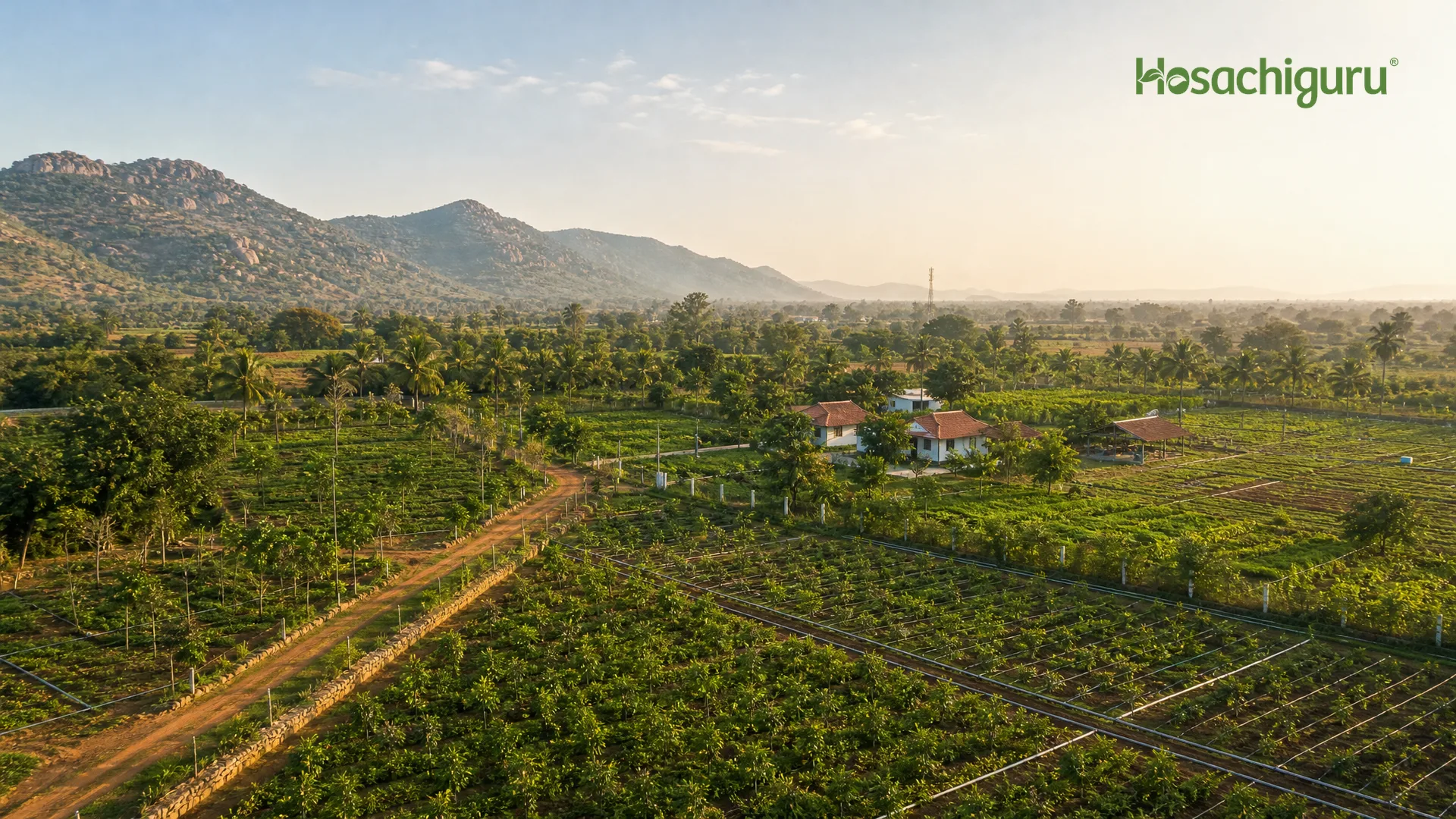
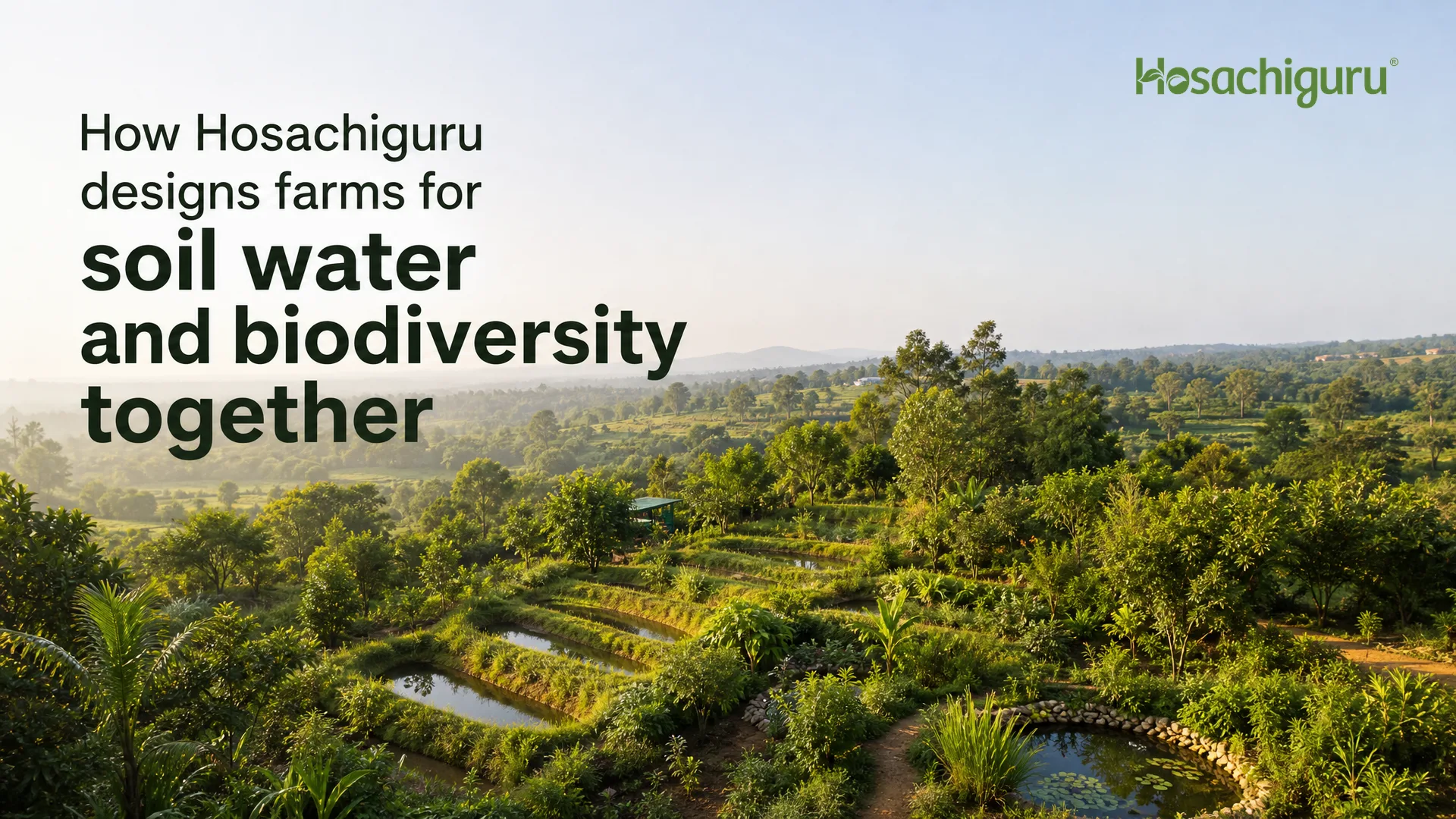
When you evaluate farmland near Bengaluru, you probably compare soil type, water source, and tree cover as separate line items. Hosachiguru approaches the same land differently. On every managed farmland project in Karnataka, soil, water, and biodiversity are designed as one connected system, because that is how regenerative agriculture actually works on the ground.
TL;DR – Summary
- What is regenerative agriculture? – Regenerative agriculture is a farming approach that actively rebuilds soil organic carbon, restores water cycles, and increases biodiversity rather than merely sustaining current conditions. Hosachiguru applies this framework across its managed farmland projects near Bangalore.
- Why design soil, water, and biodiversity together? – These three elements form a feedback loop. Healthy soil retains more water, retained water supports diverse plant and animal life, and biodiversity returns nutrients to the soil. Treating them separately weakens each one.
- How does Hosachiguru implement this? – Through layered food forest planting, rainwater harvesting with recharge systems, drip irrigation, companion cropping, and habitat creation for pollinators and indigenous species. Each project’s master plan integrates these from day one.
- What does this mean for owners? – Farmland owners receive land that can improve in ecological value over time, producing chemical free harvests while supporting long term soil health and water conservation without requiring personal farming expertise.
Why integrated design matters
Conventional farm planning often treats soil fertility, irrigation, and wildlife as separate budget items. A borewell goes here, fertilizer goes there, and biodiversity is an afterthought. That fragmented approach can degrade land over time.
Regenerative agriculture reverses this logic. It starts from the premise that soil, water, and living organisms co-create productive land. When one element weakens, the others follow. When all three strengthen together, the farm becomes a self-sustaining ecosystem.
Hosachiguru builds every managed farmland project around this principle. From Chikkaballapur in North Bangalore to Ramanagara along the Mysore highway, the design philosophy stays consistent: plan the land as a living system, not a collection of features.
Soil first planning
Every Hosachiguru project begins with plot specific soil testing. The agronomy team evaluates pH level, nutrient profile, organic carbon content, drainage capacity, and microbial activity before a single tree is planted.
This data shapes crop planning and tree mix decisions. Companion planting pairs species that fix nitrogen with species that need it. Mulch layers protect topsoil from erosion and feed microbial communities below the surface.
Over successive seasons, these practices can help raise soil organic carbon. Higher carbon content improves water retention, reduces the need for external inputs, and creates conditions where chemical free farming becomes practical rather than aspirational.
Water as a cycle, not a supply
Water management in farming is often reduced to one question: is there a borewell? Hosachiguru treats water as a full cycle. Rainwater harvesting structures, including swales, farm ponds, open wells, and recharge systems, capture monsoon rainfall and direct it back into the water table.
Drip irrigation delivers water to root zones with minimal waste. Drainage planning prevents waterlogging during heavy rains. Greywater reuse closes another loop. Together, these systems are designed to reduce dependence on borewells and buffer the farm against dry summers.
This approach matters especially for farmland near Bangalore, where groundwater levels face pressure from urban expansion. A farm that recharges more water than it extracts is a more resilient long term asset.
Biodiversity by design
Biodiversity on a Hosachiguru farm is not accidental. Food forest layers, from tall canopy trees down through fruit trees, shrubs, and ground cover, create vertical habitat structure. Mixed species planting attracts pollinators, beneficial insects, and indigenous bird species.
Ponds and open wells serve double duty: irrigation reserve and habitat for amphibians and aquatic life. Native flowering species planted along borders support bee populations that improve pollination across the entire farm.
This habitat creation feeds back into soil health. Diverse root systems break up compacted earth. Leaf litter from multiple species enriches the mulch layer. Animal activity distributes seeds and nutrients. The result is a farm where biodiversity restoration and productive agriculture reinforce each other.
How the system connects
Consider a single rain event on a Hosachiguru managed farm plot. Water hits a mulch covered surface and infiltrates slowly instead of running off. Swales channel excess flow into recharge pits. The water table rises gradually.
Meanwhile, soil microbes thrive in the moist, carbon rich topsoil. Companion crops draw nutrients fixed by neighboring legumes. Pollinators visit flowering food forest layers. Fruit trees set better yields because of improved pollination.
No single intervention produces this outcome. It emerges from the integrated design, where soil health, water management, and biodiversity conservation are planned as one system from the master plan stage onward.
What owners gain
For farmland owners, this integrated approach can translate into several practical benefits. Chemical free produce from land managed with zero residue methods. Soil that is designed to improve rather than deplete. Water systems that aim to sustain the farm through Karnataka’s variable rainfall patterns.
Hosachiguru’s on ground farm management team handles the daily work: pruning cycles, irrigation planning, soil care, seasonal optimisation, and harvest timing. Owners can track progress through the MyFarm app, which provides real time farm updates, harvest reports, and water management data.
This means a family in Bengaluru can own regenerative farmland, enjoy weekend farm visits, and receive farm fresh food without needing personal farming experience. The land is designed to function as a living system whether the owner visits weekly or monthly.
Evaluating managed farmland near Bangalore becomes clearer when you understand this integrated logic. Rather than comparing isolated features, look for evidence that soil, water, and biodiversity have been planned together. That is the foundation of regenerative farmland, and it is the design principle Hosachiguru applies across every project in Karnataka.
FAQs
1. What is regenerative agriculture?
Regenerative agriculture is a farming system that actively rebuilds soil health, restores water cycles, and increases biodiversity. It goes beyond organic certification by focusing on measurable ecological improvement over time, not just the absence of chemical inputs.
2. What is water management in farming?
Water management in farming involves capturing, storing, distributing, and recharging water efficiently. Hosachiguru uses rainwater harvesting, drip irrigation, swales, recharge pits, and drainage planning to create a closed loop water cycle on each managed farm plot.
3. How does Hosachiguru support biodiversity on its farms?
Hosachiguru designs multi layered food forests, plants indigenous flowering species, and creates pond habitats. These features attract pollinators, beneficial insects, and native wildlife, which in turn support soil health and improve crop pollination across the farm.
4. Can regenerative farmland improve soil and biodiversity?
Yes. When soil care, water retention, and habitat creation are designed together, each element can strengthen the others. Healthy soil supports diverse plant life, diverse plants attract wildlife, and wildlife activity returns nutrients to the soil over successive seasons.