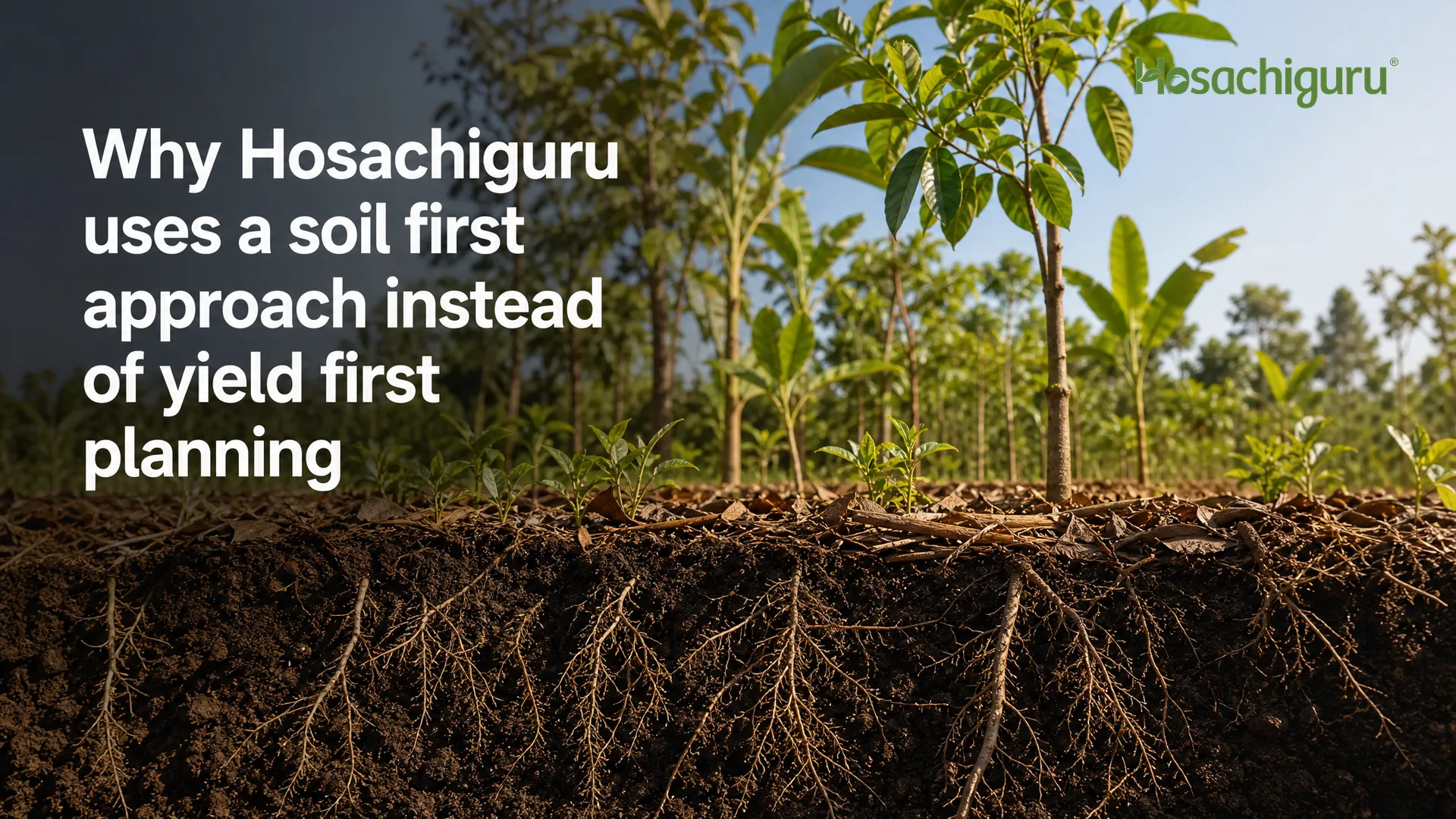
Most buyers evaluating managed farmland near Bangalore ask a familiar question first: what will this land yield? Hosachiguru starts with a different question. Before counting harvests, the agronomy team asks what the soil can sustain over decades. That distinction, soil first versus yield first, shapes every planting decision, every water system, and every long term outcome on Hosachiguru’s regenerative farmland projects across Karnataka and the Andhra Pradesh border.
TL;DR – Summary
- What is a soil first approach? – A soil first approach means every crop plan, irrigation layout, and tree mix begins with detailed soil analysis. Hosachiguru tests pH, organic carbon content, drainage, and microbial activity on each plot before any planting starts, so the land’s biology guides decisions rather than short term yield targets.
- Why not plan for yield first? – Yield first planning often relies on chemical inputs and monocropping to maximize output quickly. Over time, this depletes soil organic carbon, weakens water retention, and raises the risk of crop failure. Hosachiguru avoids that cycle by building soil fertility before scaling harvests.
- How does this connect to regenerative agriculture? – Regenerative agriculture restores soil health through practices like companion planting, mulch layering, and mixed species planting. Hosachiguru applies these methods on its managed farmland near Bangalore, aiming to increase biodiversity, improve water retention, and sequester carbon in the soil over the long term.
- What does this mean for buyers? – Farmland owners benefit from healthier soil that can produce chemical free food, support diverse food forests, and appreciate in ecological value. Hosachiguru’s soil first planning is designed to help protect the land’s productivity across seasons and generations, not just the next harvest cycle.
What yield first planning misses
Conventional farming often treats soil as a passive medium. Seeds go in, fertilizers follow, and the harvest calendar dictates everything. This model can deliver strong short term output, especially with chemical inputs and monocropping.
The trade off appears over time. Soil organic carbon declines. Water retention drops. Microbial communities shrink. Each successive season may require heavier intervention to maintain the same output. For a farmland buyer planning to hold land for ten or twenty years, that trajectory matters.
Yield first planning also tends to ignore site specific conditions. Two plots 500 meters apart can differ sharply in pH, drainage, and nutrient profile. A blanket crop plan treats them identically. A soil first approach does not.
How Hosachiguru starts with soil
Before any tree is planted on a Hosachiguru project, the agronomy team conducts plot specific soil testing. This covers pH level, organic carbon content, drainage assessment, nutrient profile, and microbial activity. The results shape every decision that follows.
If a plot drains poorly, the team adjusts with swales, French drains, or raised bed planting. If organic carbon is low, mulch layers and companion crops come first. If the pH favors certain fruit trees over others, the tree mix reflects that reality rather than a generic orchard template.
This process aligns with regenerative agriculture principles. Instead of forcing the land to fit a plan, the plan fits the land. Hosachiguru’s agronomy support teams use these soil reports to design layered planting systems, food forests, and agroforestry layouts that work with each plot’s natural strengths.
Regenerative agriculture versus organic farming
Buyers sometimes ask how regenerative agriculture differs from organic farming. The distinction is important. Organic farming avoids synthetic chemicals and pesticides. That is a valuable constraint, but it does not automatically rebuild soil.
Regenerative agriculture goes further. It actively restores soil health through practices like cover cropping, companion planting, reduced tillage, and biodiversity restoration. The goal is not just to avoid harm but to improve the land’s biological capacity over time.
Hosachiguru’s managed farmland projects near Bangalore incorporate both. Chemical free farming is the baseline. Regenerative methods, including mixed species planting, mulch layering, rainwater harvesting, and habitat creation for pollinators, are the active strategy. The result is farmland that can become more productive and resilient with each passing year rather than less.
Why soil testing matters for buyers
Soil testing before buying farmland is one of the most practical due diligence steps a buyer can take. A soil test report reveals whether the land can support the crops or trees being promised. It also flags risks like poor drainage, chemical residues from prior use, or nutrient deficiencies that would require heavy amendment.
Hosachiguru provides plot specific soil reports as part of its farmland due diligence process. Buyers can review organic carbon content, pH, and drainage data before committing. This transparency is designed to help owners understand what their land can realistically sustain.
For managed farmland near Bangalore, where projects span corridors from Chikkaballapur and the STRR corridor in the north to Ramanagara and Denkanikottai in the south, soil conditions vary significantly. A soil first approach ensures each project’s crop planning and irrigation planning reflect local ground truth, not assumptions borrowed from a different geography.
Long term value of healthy soil
Healthy soil does more than grow food. It retains water, reducing dependence on borewells and external irrigation. It sequesters carbon, contributing to a reduced carbon footprint. It supports biodiversity, from microbial communities underground to pollinators and indigenous species above ground.
For farmland owners, these ecological functions translate into practical benefits. Better water retention means lower irrigation costs and greater resilience during dry summers. Higher organic carbon means richer harvests of farm fresh food without chemical inputs. Greater biodiversity means natural pest management and a self sustaining ecosystem that requires less intervention over time.
Hosachiguru’s soil first planning is designed to help build these outcomes gradually. The approach prioritizes soil regeneration, water conservation, and layered canopy formation as foundations. Harvests follow naturally from that foundation rather than being extracted at its expense.
For buyers evaluating organic farmland near Bangalore, the question worth asking is not just “what will this land produce next season?” It is “what will this land be capable of producing in ten years?” Hosachiguru’s soil first approach is built to answer the second question with confidence, grounding every managed farmland project in agronomic reasoning rather than short term yield promises.
FAQs
1. What is regenerative agriculture?
Regenerative agriculture is a farming approach that actively restores soil health through practices like cover cropping, companion planting, and biodiversity restoration. Hosachiguru applies these methods on its managed farmland to improve soil organic carbon, water retention, and long term land productivity.
2. How is regenerative agriculture different from organic farming?
Organic farming avoids synthetic chemicals. Regenerative agriculture goes further by actively rebuilding soil biology through mulch layering, mixed species planting, and habitat creation. Hosachiguru combines both, using chemical free methods as a baseline and regenerative practices as the active strategy.
3. Why is soil testing important before buying farmland?
Soil testing reveals pH, organic carbon, drainage, and nutrient levels, helping buyers verify whether the land can support promised crops. Hosachiguru provides plot specific soil reports as part of its due diligence, so owners understand their land’s real capacity before planting begins.
4. Does Hosachiguru offer organic farmland near Bangalore?
Hosachiguru operates managed farmland projects across corridors near Bangalore, including Chikkaballapur, Ramanagara, and Denkanikottai. All projects follow chemical free farming practices and use regenerative methods like food forest design, agroforestry, and rainwater harvesting to build soil health.