
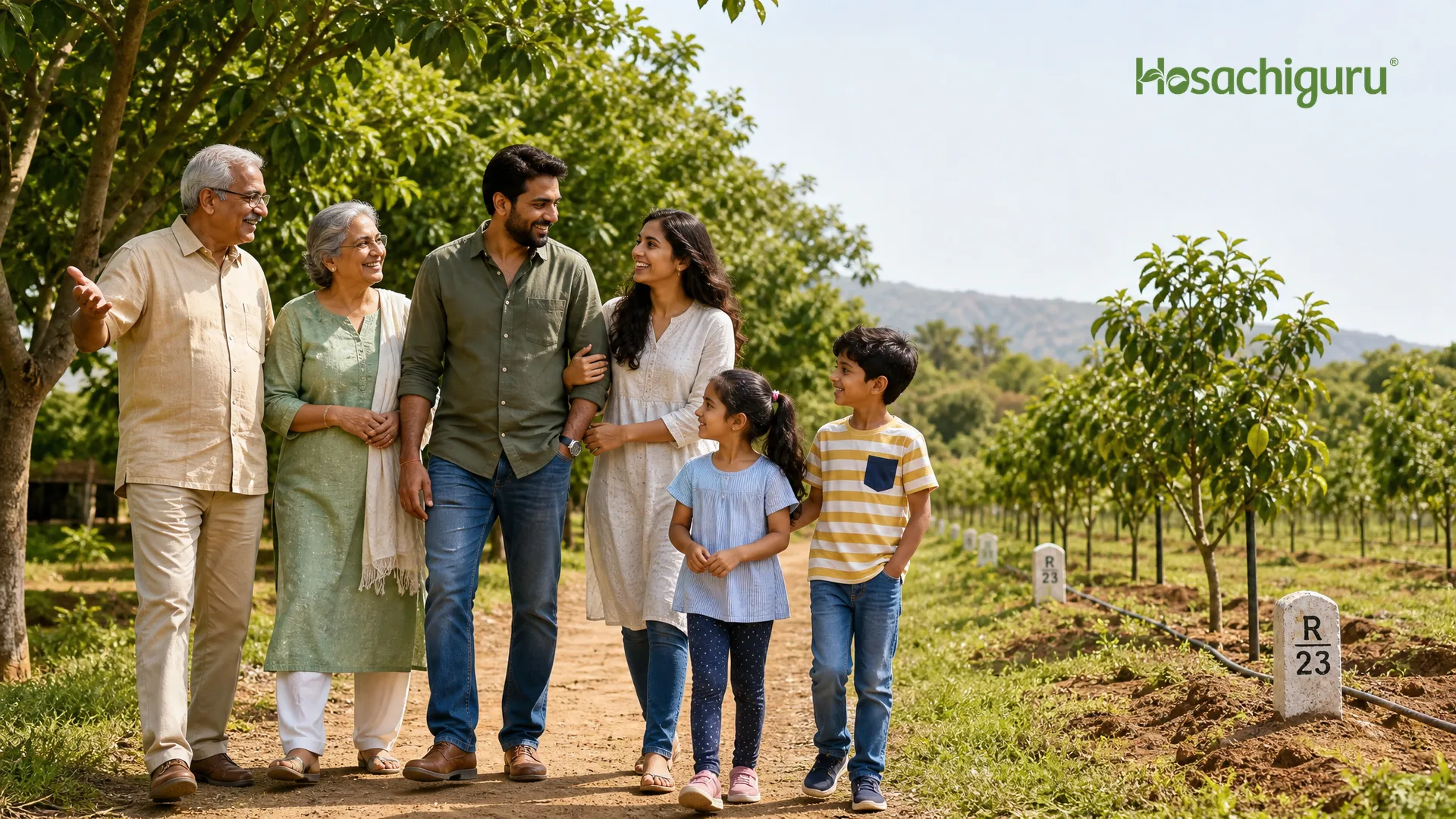
You have been reading about managed farmland near Bangalore for weeks. Now the family is ready to visit a project for the first time, and everyone is coming along: your partner, your parents, maybe the children too. A good first visit should help you assess the land, verify documents, judge the management setup, and decide whether this place fits your family’s goals.
TL;DR – Summary
- What should a first visit cover? – A first visit to managed farmland near Bangalore should let you inspect the land and water, verify legal documents, evaluate the management model, and check whether the site is comfortable for elders and children.
- What to do before leaving Bengaluru? – Confirm your visit slot, request the survey number and title documents in advance, plan the route with rest stops, and agree on a family question list so everyone knows what to look for.
- What to check on site? – Walk the boundary to match survey stones with the sketch, inspect the water source and soil condition, check the approach road, ask about plantation age and maintenance charges, and note shade, seating, and restroom access for elders.
- What should NRI families arrange ahead? – Carry identity documents, note any power of attorney requirements, and confirm farmland eligibility rules with a lawyer before the trip, since you may get only one visit window.
- What to do after the visit? – Request the title deed, encumbrance certificate, and RTC extract, get an independent lawyer to verify them, compare family notes, and plan follow up questions or a second visit.
Before you leave Bengaluru
Preparation turns a casual outing into a productive assessment. These steps help every family member, from the couple handling paperwork to the elders who will read the soil, arrive ready. NRI families on a short trip should pay special attention to the document and eligibility items below.
- Confirm your visit slot and ask who will guide you on site. A dedicated relationship manager or agronomist walkthrough is far more useful than a self guided tour, so clarify this when you book.
- Request the survey number and a copy of the title documents before you go. You can share these with a lawyer for a preliminary check, saving time during or after the visit itself.
- Map the drive from your Bengaluru starting point, noting distance, estimated time, fuel stops, and a breakfast or chai halt. Many managed farmland projects sit 45 to 90 minutes from the city, so plan for comfort.
- Visit early in the morning or late afternoon to avoid peak heat. If possible, choose a post monsoon month when the land shows its true water retention, greenery, and soil condition rather than a dry summer picture.
- Pack water bottles, snacks, sunscreen, hats, and closed shoes for children. For elders, carry any regular medicines, a cap, and comfortable footwear suited to uneven farm paths and soft soil.
- Sit together the evening before and list each person’s questions. Let elders note what they want to check about soil and water. The couple can focus on costs and legal clarity. Writing questions down prevents important items from slipping your mind on a busy visit day.
- NRI families should carry passport copies, OCI or PIO cards, and any existing power of attorney documents. Confirm current farmland purchase eligibility rules for your specific situation with a lawyer before you travel, as regulations can change and vary by state.
On site: what to look at and what to ask
This is the core of your visit. Group your observations into clear areas so nothing gets missed. Let each family member lead where their strengths lie. Elders with farming backgrounds can assess soil and water while the couple focuses on paperwork, costs, and infrastructure details.
Land and boundaries
- Walk the full boundary of the plot you are considering. Look for survey stones at each corner and compare their positions against the survey sketch the project shared with you beforehand.
- Check whether the plot is fenced or demarcated clearly. In a managed farmland project, internal roads and fencing are usually part of the master plan, so ask to see the layout map.
- Note the shape and gradient of the land. Flat or gently sloping plots drain better and are easier to plant. Ask the guide how plot allocation works and whether you can choose a specific parcel.
Water and soil
- Ask about the primary water source: borewell, open well, rainwater harvesting system, or a combination. A well managed project typically has drip irrigation lines connected to a central water network with recharge systems in place.
- Look at the soil colour, texture, and moisture level. This is where elders with farming experience can lead. Dark, crumbly soil with visible organic matter and earthworm activity signals good health.
- Ask whether a soil test report is available for the specific plot. A credible project should be able to share pH, nutrient profile, and organic carbon data, or at least explain their soil care practices clearly.
- Check for signs of water stress: wilting leaves, dry drip lines, or yellowing crops. If the visit falls in summer, ask how the project manages water during peak dry months and what the borewell recharge rate looks like.
Access and safety
- Drive the approach road yourself and note its condition. Ask whether it stays usable during heavy monsoon rains, since a beautiful plot loses practical value if the road washes out three months a year.
- Check for a gate, perimeter fencing, and any security or surveillance setup. Ask how the project handles access for owners who visit on weekends versus the farm management team present on weekdays.
- Note the distance to the nearest town, hospital, and fuel station. For families with young children or elderly parents, proximity to emergency medical care is a practical concern worth confirming early.
Plantation and management
- Look at the crops and trees already planted. Ask their age, species mix, and expected timeline to maturity. A mango orchard, for instance, takes several years before it bears fruit, so understanding the stage matters.
- Ask who handles day to day farm work: an in house agronomy team, contracted labour, or a combination. In a professionally managed model, an on ground team typically manages pruning, irrigation, pest control, and seasonal crop planning.
- Find out how owners who live in the city or abroad receive updates. Some projects use a dedicated app to share harvest reports, photos, water management data, and payment tracking, which is especially valuable for NRI owners.
Costs and charges
- Ask for a clear breakdown of maintenance charges, often called AMC. Understand what the fee covers: agronomy, irrigation, security, common area upkeep, and whether harvest logistics or clubhouse access is included or separate.
- Clarify how often maintenance charges are revised and what process governs increases. Transparent pricing with a written schedule helps you plan long term costs without surprises after you have already purchased the plot.
Family comfort on site
- Check for shade structures, seating areas, and clean restrooms. Elders and young children need places to rest during a visit that may last two to three hours, especially in warm weather.
- Walk the paths yourself and note uneven ground, loose stones, or steep sections. Ask whether the project has a clubhouse, cottage, or hospitality area where the family can sit, have a meal, and discuss impressions together.
- See where children can safely explore. A well planned project often has community spaces, walking trails, or a small garden area where kids can move around without wandering into active farm zones or near equipment.
After the visit: documents, notes, and next steps
The visit itself is only half the job. What you do in the days that follow determines whether you move forward with confidence or leave gaps that cause trouble later. Treat this stage with the same discipline you brought to the site.
- Request copies of the title deed, encumbrance certificate, RTC or pahani extract, and conversion order if the land has been converted. These are the core documents for any farmland purchase in Karnataka.
- Engage an independent lawyer to verify the documents. Do not rely solely on the project’s in house legal team. Your lawyer should confirm clear title, check for encumbrances, and advise on eligibility under current Karnataka land laws.
- Sit together as a family and compare notes. What did the elders notice about the soil and water? What did the couple think about costs and legal clarity? Writing a shared summary helps when you revisit the decision a week later with fresh eyes.
- Send any follow up questions to the project team in writing and note their response time and clarity. For NRI families who have flown back, ask whether a video walkthrough or a second virtual tour can be arranged before you commit.
- If you are seriously interested, plan a second visit in a different season. Seeing the land in both monsoon and summer gives you a fuller picture of water availability, road access, and overall farm health across the year.
Printable checklist summary
Before you leave
- Confirm visit slot and guide assignment.
- Request survey number and title documents in advance.
- Plan route, drive time, and rest stops.
- Choose a cool time of day and a post monsoon month if possible.
- Pack essentials for children and elders.
- Prepare a shared family question list.
- NRIs: carry ID documents and confirm eligibility with a lawyer.
On site
- Walk the boundary and match survey stones to the sketch.
- Inspect water source, drip lines, and borewell setup.
- Let elders assess soil colour, texture, and moisture.
- Check approach road condition for all seasons.
- Note gate, fencing, and security arrangements.
- Ask about plantation age, species, and management team.
- Clarify maintenance charges and revision terms.
- Check shade, seating, restrooms, and safe areas for children.
After the visit
- Collect title deed, EC, RTC, and conversion documents.
- Get an independent lawyer to verify everything.
- Compare family notes and write a shared summary.
- Send follow up questions in writing.
- Plan a second visit in a different season or request a video walkthrough.
You now have a clear, stage by stage framework for your first visit to managed farmland near Bangalore. Print this checklist, share it with your family, gather your questions, and book a site visit with Hosachiguru when you are ready. Their team can walk you through the land, documents, and management model in one visit, so every family member leaves with the answers they need.
FAQs
1. What documents should I ask for before visiting managed farmland near Bangalore?
Request the survey number, a copy of the title deed, and any available survey sketch before your visit. Having these in hand lets you or your lawyer do a preliminary title check ahead of time. This saves valuable hours on site and helps you ask sharper questions during the walkthrough.
2. Can NRI families buy managed farmland in Karnataka?
Eligibility rules for NRIs purchasing agricultural land in Karnataka depend on citizenship status, residency documents, and current state regulations. Rules can change, so confirm your specific situation with an independent lawyer before your visit. Carry passport copies, OCI or PIO cards, and any power of attorney documents.
3. What should elders look for during a farmland site visit?
Elders with farming backgrounds can assess soil colour, texture, moisture, and signs of healthy microbial activity like earthworms. They can also spot water stress in crops, evaluate borewell output, and judge whether the plantation spacing and species mix look well planned for the region.
4. How do managed farmland projects share updates with owners living in the city?
Many professionally managed projects use a dedicated app or regular reports to share harvest updates, farm photos, water management data, and payment tracking. This is especially helpful for owners in Bengaluru or abroad who cannot visit frequently but want visibility into day to day farm operations.
5. What is included in farmland maintenance charges?
Maintenance charges, often called AMC, typically cover agronomy support, irrigation management, security, common area upkeep, and seasonal crop care. Some projects include clubhouse access or harvest logistics. Always ask for a written breakdown and clarify how often the charges are revised before you purchase.
6. Is it safe to visit managed farmland near Bangalore with young children?
Most well planned projects have internal roads, fenced boundaries, and community spaces where children can walk safely. Pack water, snacks, hats, closed shoes, and insect repellent. Check for shade, seating, and restrooms on site so the visit stays comfortable for the whole family.
7. How do I verify the title of farmland before buying?
Collect the title deed, encumbrance certificate, RTC or pahani extract, and conversion order if applicable. Engage an independent lawyer to verify clear title, check for liens or disputes, and confirm your eligibility under current Karnataka land laws. Do not rely solely on the seller’s legal team.