You signed the sale deed, completed registration, and received your title documents. Now what? For most managed farmland buyers, especially busy professionals in Bengaluru, the weeks after purchase bring a quiet but persistent question: how will I know what is actually happening on my land? Hosachiguru addresses this gap by treating post purchase transparency not as a bonus, but as a core part of the managed farmland relationship.
TL;DR – Summary
- What does post purchase transparency mean? – It refers to the ongoing flow of farm operations data, harvest reports, land documents, and visit access that owners receive after buying managed farmland. Without it, absentee ownership becomes a trust problem rather than a lifestyle benefit.
- How do managed farm plots work after purchase? – A professional farm management team handles agronomy, irrigation planning, soil care, and seasonal crop cycles. Owners stay informed through regular updates, the MyFarm app, and scheduled farm visits rather than performing daily farm work themselves.
- What is the MyFarm app? – The MyFarm app is Hosachiguru’s owner facing platform that provides real time farm updates, harvest reports, payment tracking, land documents access, and water management data, all from a single dashboard on the owner’s device.
- Why does ongoing visibility matter for farmland owners? – Post purchase opacity is a common weakness in the managed farmland category. Consistent transparency through operations data, site visits, and documented harvests helps owners verify that their land is being stewarded responsibly over the long term.
Why post purchase opacity persists
Most farmland conversations focus on what happens before you buy. Legal due diligence, title verification, soil testing, and RERA compliance dominate the pre sale stage. These steps matter. But they answer a different question than the one owners face once the sale deed is signed.
After registration, the information rhythm often drops. Owners who live 45 to 90 minutes from their plots cannot visit every week. Without a structured update cadence, they rely on occasional phone calls or sporadic photos. That gap between ownership and awareness is where skepticism about absentee farmland ownership takes root.
Hosachiguru’s approach is designed to close that gap. Rather than treating the transaction as the finish line, the managed farmland model positions it as the starting point of a long term stewardship relationship.
How managed farm plots work after you buy
In a professionally managed farmland setup, the on ground team handles agronomy, irrigation planning, soil care, pest management, pruning cycles, and harvest timing. Owners hold the legal title. The farm management team handles the daily operations.
This division only works when owners can verify what is happening. Hosachiguru structures this verification around several channels. Periodic operations reports cover soil health metrics, water management data, crop planning updates, and seasonal optimisation notes. Harvest reports document what was produced, when it was picked, and how it was distributed.
Owners also retain the ability to visit their plots. Family farm visits are encouraged, not restricted. Weekend access means owners can walk their land, see the tree mix, inspect the mulch layer, and observe the drip irrigation systems firsthand. The farm is not a black box.
What the MyFarm app provides
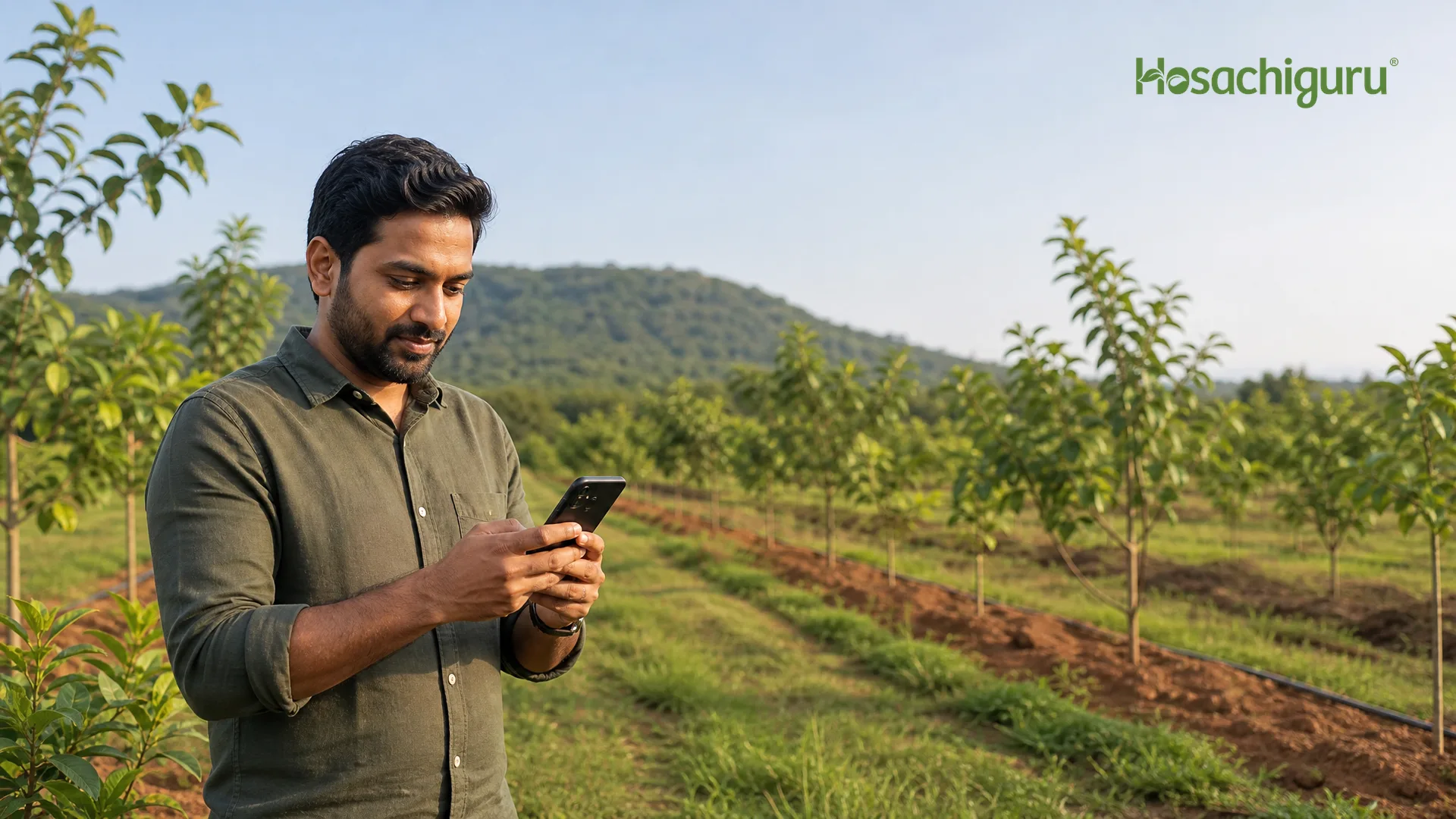
The MyFarm app is Hosachiguru’s digital transparency layer. It consolidates the information an owner needs into a single interface. Rather than waiting for a quarterly email or requesting documents manually, owners can open the app and see current data.
Key features include real time farm updates on activities like planting, soil analysis, and irrigation adjustments. Harvest reports show seasonal produce volumes and timelines. Payment tracking keeps financial records accessible. Land documents, including sale deed records and ownership records, remain available for download at any time.
Water management data is another critical element. Owners can review borewell status, rainwater harvesting performance, and recharge rate information. For plots in regions like Chikkaballapur, Ramanagara, or Denkanikottai, where water planning varies by season, this visibility can help owners understand how their land is being sustained through dry months.
The app transforms the owner’s relationship with their plot from passive to participatory, without requiring them to perform any farm work.
What transparency should feel like
Transparency after buying managed farmland should not feel like a reporting obligation fulfilled by the management company. It should feel like a natural extension of ownership. Here is what that looks like in practice.
First, it means receiving updates without having to ask. The information rhythm should be proactive, not reactive. Soil health reports, crop planning notes, and irrigation data should arrive on a schedule the owner can rely on.
Second, it means access to raw records. Not just summaries, but the underlying documents: soil test reports with pH and organic carbon content, water management logs, and harvest data broken down by plot. Hosachiguru’s approach through the MyFarm app is designed to provide this level of detail.
Third, it means physical access. Owners should be able to visit during harvest season, bring their families for a weekend retreat, and see the food forest layers, companion planting, and biodiversity on their land. Transparency is not only digital. It is also experiential.
Fourth, it means continuity. The information flow should not diminish after the first year. Long term upkeep, AMC details, and seasonal changes should remain visible for as long as the owner holds the title. Hosachiguru positions itself as a long term steward, not a one time seller, and this continuity is where that commitment becomes tangible.
Why this matters for busy professionals
The typical managed farmland owner near Bangalore is a working professional or a family with limited time for regular site visits. They chose managed farmland precisely because they wanted farmland ownership without daily farm work. But ownership without visibility creates anxiety, not freedom.
When the MyFarm app shows a recent soil analysis, or when a harvest report arrives with photos and produce data, the owner’s confidence in their investment is reinforced. They do not need to drive to Hindupur or Bagepalli every month. They can verify stewardship from their phone.
This is especially relevant for co farming communities, where multiple owners share a project’s infrastructure. Transparent management practices across the community, from security and surveillance to clubhouse amenities and internal roads, help maintain trust among all co farmers.
Post purchase transparency is not a feature. It is the foundation of hassle free farmland ownership. Without it, managed farmland is just land you bought and hope someone is caring for. With it, managed farmland becomes a living asset you understand, visit, and trust.
FAQs
1. How do managed farm plots work?
Managed farm plots operate through a professional farm management team that handles agronomy, irrigation, soil care, and harvests. Owners hold the legal title while the team manages daily operations, providing regular updates through reports and tools like the Hosachiguru MyFarm app.
2. What is the MyFarm app?
The MyFarm app is Hosachiguru’s owner facing platform for managed farmland transparency. It provides real time farm updates, harvest reports, payment tracking, land documents access, and water management data, giving owners visibility into their plot from any location.
3. How does the MyFarm app help farm owners?
The MyFarm app helps farm owners stay informed without visiting their plot daily. It consolidates soil health data, irrigation logs, harvest timelines, financial records, and ownership documents into one interface, supporting confident and hassle free farmland ownership.
4. Can farmland owners visit their managed plots anytime?
Yes. Hosachiguru encourages family farm visits and weekend access. Owners can walk their land, observe farming activities, and experience the food forest, biodiversity, and community amenities firsthand, reinforcing the transparency that digital updates provide.