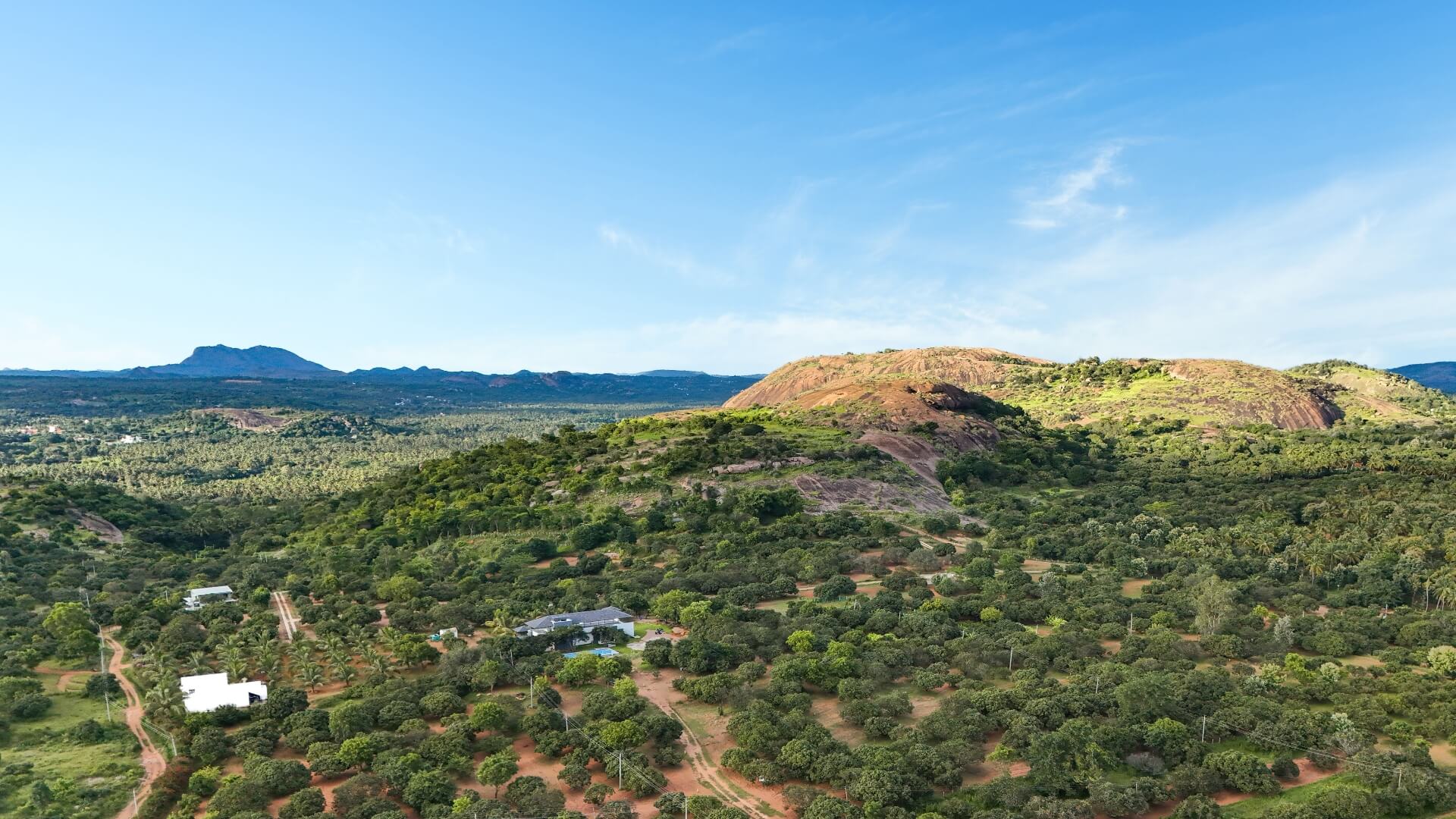
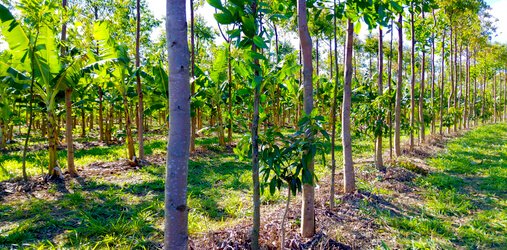
Agroforestry is a low-cost method of integrated land management where trees are cultivated along with cash crops. Cultivating trees in combination with crops and cattle is an ancient traditional practice across South-east Asia. In India, the practice of growing sacred trees scattered across farms is an age-old practice. Most efforts in agroforestry have been focused on the biophysical benefits of enhancing the environment. Hosachiguru farms revive agroforestry by spotlighting both its biophysical and socio-economic benefits to the community.
A 2017 report by the World Wildlife Fund and the Planning Commission of India, projected a severe shortage of timber supply in India from both domestic and international sources by 2020. Moreover, India is the third largest importer of illegally logged timber (after China and Vietnam), contributing to 9.4% of the total illegal timber import in the world (Gan, et al., 2016). With fertile land, tropical climate, and appropriate irrigation techniques, agroforestry can promote an ‘Atmanirbhar’ Indian timber supply chain, reducing the requirement for timber imports while supporting local economies of scale. Annually, India consumes an estimated 69 million cum* of timber (Shrivastava & Saxena, 2017). To cater to the rising demand of timber and forest produce, India needs to make sustainable use of its underutilised and unproductive wastelands by developing them into cultivable agroforest systems. Agroforestry will not only improve the productivity of timber in India but will also protect forests from deterioration by anthropogenic factors, such as illegal logging, encroachment and climate change.
Agroforestry model works on the principle of interaction between two systems (forests and agriculture) and the effect of one on the other. Agroforestry can be broadly classified into two types:
Simultaneous systems, where trees and crops are grown together in distinct spatial arrangements. Eg: Trees on cropland or trees intercropped with seasonal crops.
- Sequential systems, where trees and crops are grown in rotation. Eg: crop harvest followed by tree harvests (grown alternately).
Payment for Ecosystem Services (PES) is an internationally popular mechanism that encourages landowners or farmers to plant trees on their agricultural land. PES is a scheme employed by several international governments to increase green cover. It is a market-based approach to improve environmental management of agricultural lands that provides monetary compensation to land stewards for ecosystem conservation. (Milder, et al., 2010). In essence it is a scheme that pays ‘cash for conservation’. Most PES budgets are a drain on government resources and funds. Latin American countries like Costa Rica, Brazil & Ecuador have seen great success with PES, alleviating poverty and expanding green cover (UNDP, 2020). At Hosachiguru, we have developed a holistic approach that is fundamentally aligned with the motivation behind PES, but we support an increase in green cover which is highly profitable and triggers a cascade of socio-economic benefits for the whole community.
Biophysical Benefits of Agro forestry
The controlled interaction between the forest and agriculture systems creates conditions that are mutually favourable. The benefits from these interactions include:
- Improved Soil Fertility: Chemical soil fertility is improved as the agroforestry model increases the bioavailability of essential nutrients in the soil. Physical and Biological fertility is improved as the soil structure and water holding capacity increases.
Chemical Soil Fertility
| Carbon | Trees and crops create an active pool of Soil Organic Matter (SOM) through litter, root turnover, tree pruning & crop residues |
| Nitrogen | Intercropping increases, soil nitrogen by increasing nitrogen fixation, deep soil nitrogen capture and reduced leaching |
| Phosphorous | Aids in the critical transformation of inorganic-P to absorbable organic-P |
| Ca, Mg, K (Cations) & Al | Cations are relocated in the soil profile and Al is detoxified by organic acids. |
Source: Adapted from Rao, et. al., 1998
- Reduced levels of Soil Erosion: Strong & deep-rooted trees bind soil, increase its porosity, store soil moisture and reduce run-off and leaching.
- Increased Nutrient Cycling of organic matter and nutrients (N, P, K, Ca)
- Higher Crop Yields: As a result of increased nutrient availability, crop yield is higher
- Induces Favourable Micro-climate conditions: Tree canopies provide shade, reduced soil and air temperature and intercept and re-distribute rainfall (Rao, et al., 1998).
- Reduced Competition: Agroforestry induces sharing of growth resources such as light, water and soil nutrients.
- Increased soil microbial biodiversity: Micro-flora and fauna populations increase along with rhizobial microbes that help in nitrogen fixing.
- Watershed protection: Agroforestry model ensures higher soil water retention capacity and increases the water table by refilling aquifers.
Hosachiguru’s agroforestry model is managed and operated by our agronomy experts who carefully select trees and crops that are complementary rather than competitive. The deep-root system of trees creates little to no interference with the shallow root systems of crops and therefore the agroforestry model in itself favours polyculture of different species.
Socio-economic Benefits of Agroforestry
The National Agricultural Policy (2000) notes that ‘Agriculture has become a relatively unrewarding profession due to generally unfavourable price regime and low value addition’, which has caused a spike in migration to urban centres in India. Hosachiguru, makes agriculture an enticing opportunity and creates value addition through the revival of agroforestry. The large scale of operations lowers the set-up cost, as we cross-leverage resources between several projects, improving resource efficiency. Cross-leveraging of resources also allows our operations to function in the most environmentally sustainable manner.
Hosachiguru agro-farms also support local economies by creating jobs for marginalised rural communities and building a supply chain of product delivery (timber, fruits, vegetables, crops). Socio-economic conditions of the rural populations have seen a positive impact from our operations. The biophysical benefits of agroforestry significantly reduce the chances of crop failure. The primary advantage of agroforestry is the economic benefits it provides.
Agroforests as Carbon Sinks: Agroforestry systems have been identified as high potential carbon sinks and have the capacity to drastically alter local climate. Their ability to sequester carbon, positions them to be a critical climate change mitigation strategy for India. It has been found that in tropical regions, small scale argo-farms can sequester (capture) 1.5-3.5 MgCha-1yr-1(Roshetko, et al., 2007). Not only do they capture atmospheric carbon, they also store carbon in the accumulated biomass from leaf litter in soil humus. Agroforestry essentially offsets the carbon footprint of operating a community scale managed farmland. In the future, the majority of carbon sequestration will happen through agroforests as much of the available arable land in India is being cultivated.
Green Gold: As economies across the world are coping with the restrictions imposed by the pandemic, timber is outshining even the traditional gold and silver values. Previously, considered as a low-income investment, timber today has almost doubled in its value. The new work-from-home lifestyle has skyrocketed furniture sales as we redesign our home offices. Timber is a time-tested sustainable asset that has witnessed, a value growth rate higher than gold during the pandemic. Cultivating timber or ‘Green Gold’ has been native to the Indian-subcontinent. However, as timber resources are dwindling, future projections reveal that timber assets will support additional wealth creation opportunities.
https://youtu.be/FwVylHLf63g
The Green India Mission, under its 2008 National Action Plan on Climate Change (NAPCC) aims to restore 6Mha** of degraded forest land (Government of India, 2008; Pandve, H T., 2009). Agriculture and food production have been identified as the most vulnerable to the impacts of climate change and extreme weather fluctuations. NAPCC has recommended ‘agroforestry’ as a mechanism to develop climate resilient crops. Hosachiguru is pioneering the revival of agroforestry, creating a unique opportunity for our customers to support India’s green economy while reaping the benefits of sustainable agriculture.
*cum: cubic metres
**Mha- Million Hectares
References
Gan, J. et al., 2016. Chapter 3: Quantifying Illegal Logging and Related Timber Trade. In: D. Kleinschmit, S. Mansourian, C. Wildburger & A. Purret, eds. Illegal Logging and related timber trade- Dimensions, Drivers, Impacts and rResponses.. s.l.:IUFRO World Series 35, pp. 37-60.
Shrivastava , S. & Saxena, A. K., 2017. Wood is Good: But is India doing enough to meet its present and future needs?, s.l.: Centre for Science and Environment.
Rao, M. R., Nair, P. K. R. & Ong, C. K., 1998. Biophysical interactions in tropical agroforestry systems. Agroforestry Systems, Volume 38, pp. 3-50.
Roshetko, J. M., Lasco, R. D. & Angeles, M. S. D., 2007. Small holder agroforestry systems for carbon storage. Mitigation and adaptation strategies for Global change, Volume 12, pp. 219-242.
Puri, S. & Nair, P. K. R., 2004. Agroforestry research for development in India: 25 years of experience of a national program. Agroforestry Systems, Volume 61, pp. 437-452.
Milder, J. C., Scherr, S. J. & Bracer, C., 2010. Trends and Future Potential of Payment for Ecosystem Services to Alleviate Rural Poverty in Developing Countries. Ecology and Society, 15(2), pp. 1-19.
UNDP, 2020. Financing solutions for Sustainable Development. [Online]
Available at: https://www.sdfinance.undp.org/content/sdfinance/en/home/solutions/payments-for-ecosystem-services.html#mst-5
[Accessed 6 August 2020].
Pandve, H. T., 2009. India’s National Action Plan on Climate Change. Indian Journal of Occupational Environmental Medicine, 13(1), pp. 17-19.
Government of India, 2008. National Action Plan on Climate Change, New Delhi: Prime Minister’s Council on Climate Change.