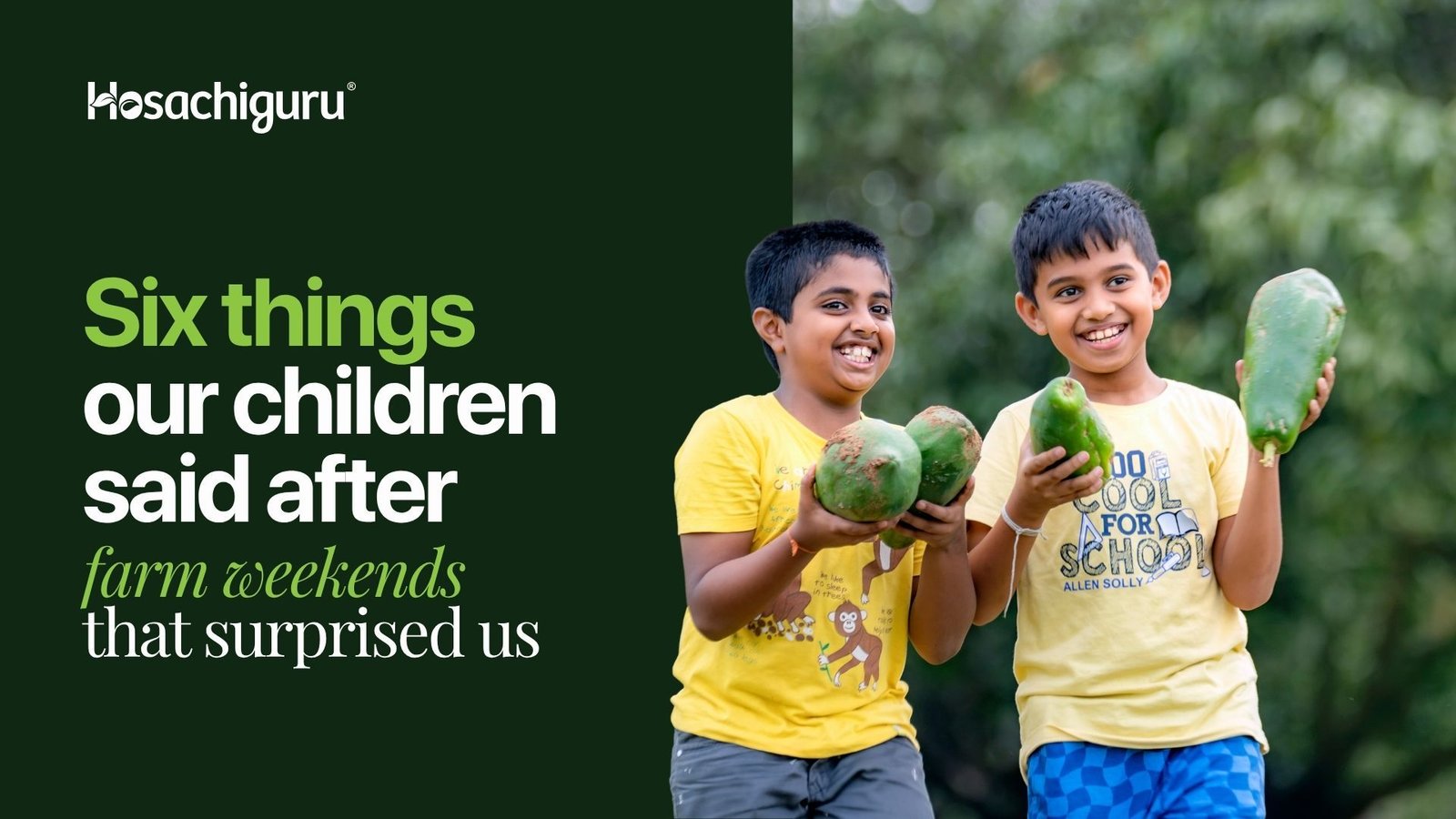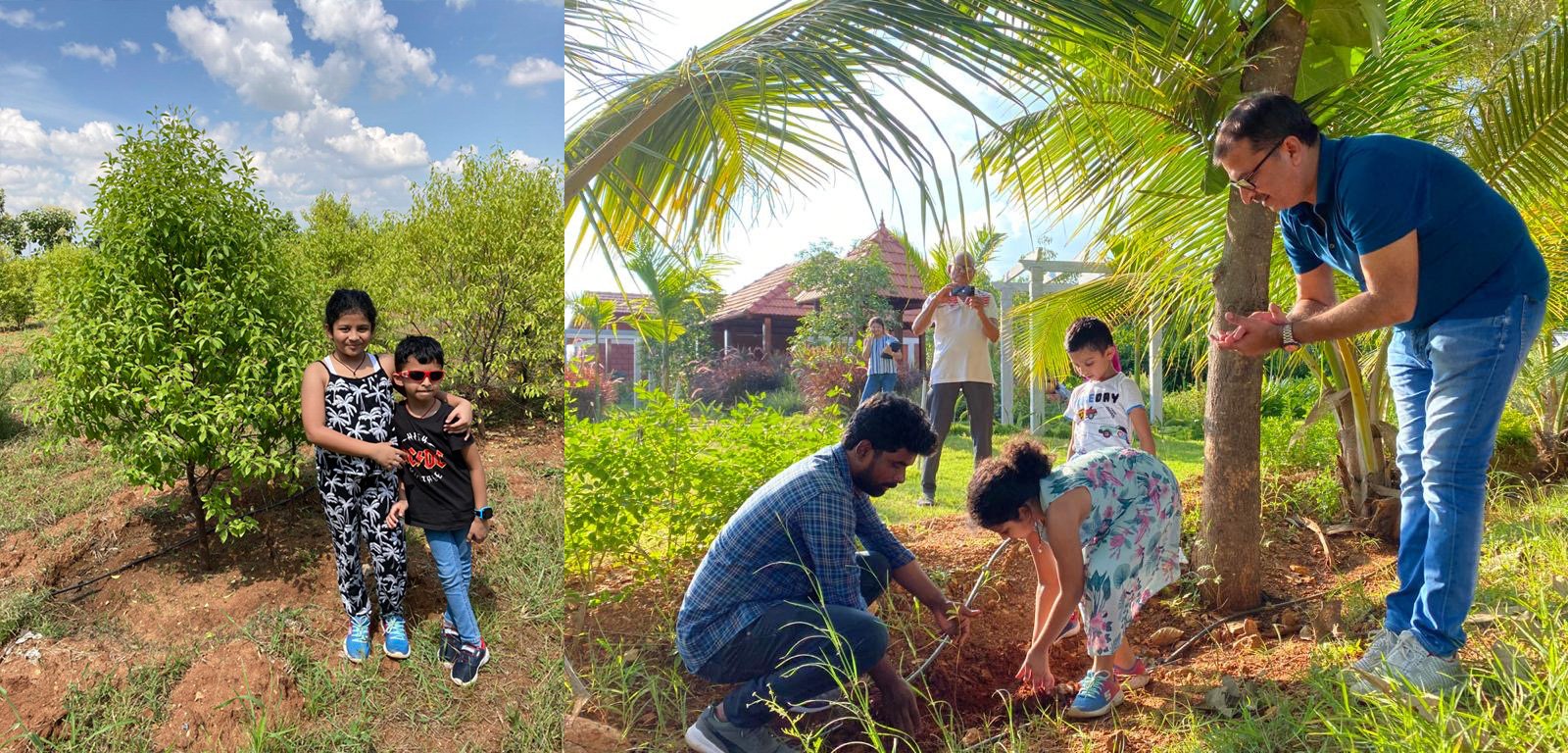
Last Sunday evening, my seven year old looked at the tomatoes on her plate and said, “Amma, these are not like the ones we picked.” She was right. The supermarket variety was pale, firm, and flavourless compared to what she had pulled off a vine just days earlier. That single sentence told me something had shifted.
TL;DR – Summary
What do kids learn from farm weekends? – Children develop a tangible connection to food, weather, effort, and patience through regular farm visits. These lessons show up in everyday conversations back home in Bengaluru.
Why do small observations matter? – A child noticing how tomatoes taste different or asking why rain matters reveals a shift in perspective that textbooks rarely achieve.
How does Hosachiguru Unnati enable this? – Located near Chikkaballapur, Hosachiguru Unnati is a managed farmland community that gives Bengaluru families regular, low effort access to farm life and organic farming experiences.
Does the value stay beyond the farm? – Yes. Parents report that children carry farm observations into school projects, meal conversations, and even grocery shopping decisions during the week.
1. “Amma, this tomato doesn’t taste like the farm one”
This was the comment that started it all. After three weekends at the farm, our daughter had developed a quiet opinion about produce. She was not being fussy. She was being specific. She could tell the difference between a tomato grown in healthy soil without chemicals and one wrapped in plastic from a cold storage unit somewhere.
For us as parents, this was a small revelation. We had spent years trying to get her interested in vegetables. No chart or cartoon mascot had worked. But pulling a warm tomato off a vine, wiping it on her shirt, and biting into it did what no dinner table lecture could accomplish.
2. “Why can’t we keep the chicken?”
Our son, age five, asked this after watching country hens scratch around the farm. He had never seen a chicken outside a picture book or a plate. The question was innocent, but it opened a conversation about where eggs come from, why animals need space, and what farm life actually looks like beyond storybook illustrations.
We did not have perfect answers. But the question itself felt like progress. He was connecting a living creature to something on his breakfast plate. That kind of thinking, linking cause and effect across his small world, is exactly what we had hoped regular farm visits near Bangalore would encourage over time.
3. “The mud smells nice after rain”
This one came from our older child during a monsoon weekend. She had been reluctant to step outside when the drizzle started. Twenty minutes later, she was ankle deep in wet earth, grinning. She told us the mud smelled “nice, like the earth is cooking something.” We looked at each other and tried not to laugh.
Petrichor is a word she learned later in school, but the sensory memory came first. That is the thing about farm weekends. Children experience weather as something that matters, not just something that cancels outdoor play.
4. “The mango is not ready yet, we have to wait”
Patience is not a skill you can teach a six year old through a lecture. But standing in front of a mango tree and being told that the fruit needs a few more weeks does something no timer or reward chart can replicate. Our son repeated this fact to his grandmother with the seriousness of a scientist delivering findings at a conference.
This is where managed farmland near Bangalore becomes more than a weekend escape. When families return regularly to the same trees and the same soil, children start to understand seasons, cycles, and the idea that good things genuinely take time. That understanding quietly filters into how they approach homework, friendships, and even waiting for dessert.
5. “The farmer uncle wakes up before the sun”
Our daughter said this with a mixture of horror and admiration. She had seen the farm management team at work early one morning and could not believe anyone functioned before seven. The comment led to a conversation about effort, about how the chemical free food on our table required someone’s daily discipline and care.
It also made her more careful about wasting food. Not because we scolded her, but because she had seen the labour behind it. That shift, from abstract awareness to personal conviction, is something we did not plan. It simply happened because she was present on a working farm often enough to notice the rhythms.
6. “Can we grow something on our balcony?”
This was the moment we realised the farm weekends had followed us home. Our son wanted to plant something, anything, in a pot on our third floor balcony in Bengaluru. We started with coriander. It died. We tried again with curry leaves. That one survived, and he checks on it every morning before school now.
The real value of our regular visits to a farm community like Unnati is not limited to the hours spent there. It is what our children carry back into their daily lives. A curiosity about soil health. A respect for effort. A preference for farm fresh food they helped pick. These are not lessons we taught. They are conclusions our children reached on their own.
When the farm comes home with you
If you are a parent in Bengaluru wondering whether weekend farm visits are worth the drive, start with one trip. Watch what your children notice. Listen to what they say on the ride home. The surprises will not be dramatic. They will be small, specific, and quietly permanent. Hosachiguru makes these visits easy to repeat, and repetition is where the real change lives.
FAQs
1. Is farm life near Bangalore good for children?
Regular farm visits give children hands on exposure to food systems, animals, weather patterns, and seasonal cycles. These experiences build curiosity, patience, and respect for effort in ways that classroom learning rarely achieves. Families near Bengaluru can access farm communities within a short drive to Chikkaballapur or similar corridors.
2. What do children learn from visiting managed farmland near Bangalore?
Children learn where food comes from, how seasons affect crops, why patience matters during harvest cycles, and how farm teams care for soil and water. These observations often translate into better eating habits, reduced food waste, and a genuine interest in nature that persists through the school week.
3. How does Hosachiguru Unnati near Chikkaballapur support family farm visits?
Hosachiguru Unnati is a managed farmland community near Chikkaballapur that provides families with regular access to organic farming, farm fresh food experiences, and outdoor activities. Professional farm management handles daily operations, so families can visit without needing agricultural expertise or committing to full time farm work.
4. Can weekend farm visits near Bangalore change how children think about food?
Yes. Children who regularly pick vegetables, watch fruit ripen, and interact with farm animals develop a sensory and emotional connection to food. Parents often notice that children become more willing to eat vegetables, ask questions about ingredients, and show less interest in processed alternatives after consistent farm exposure.
5. How far is Chikkaballapur from Bengaluru for a weekend farm trip?
Chikkaballapur is roughly 45 to 90 minutes from central Bengaluru depending on traffic and your starting point. This makes it practical for regular weekend visits rather than once a year outings. The short drive means families can leave Saturday morning and return Sunday evening without exhausting travel schedules.