
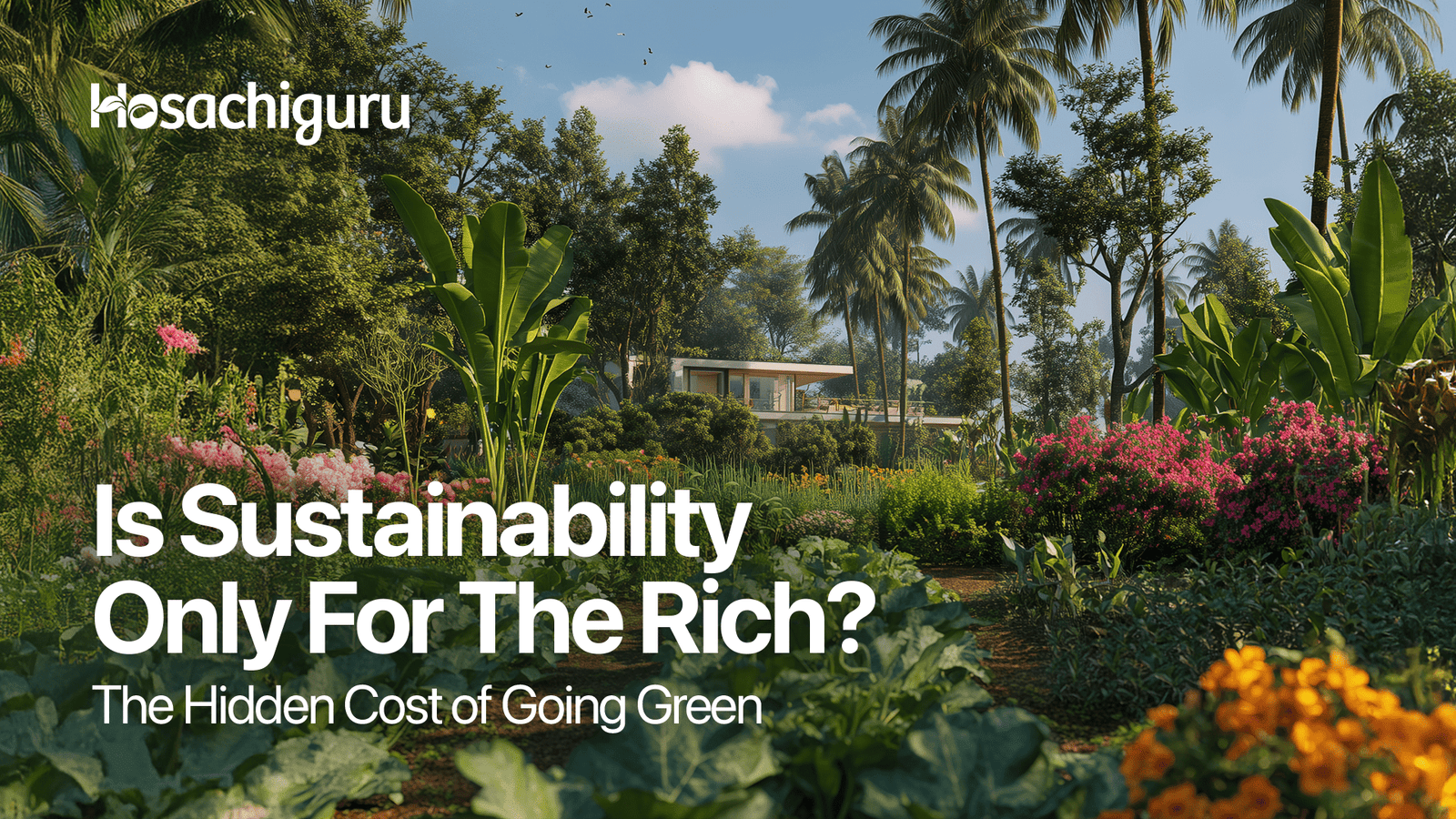
Is Sustainability Only For The Rich?

Eco-Friendly or Elite-Only? The Hidden Cost of Going Green 

Saving the planet is easy, just buy a Tesla, eat kale grown in unicorn compost, and sip iced matcha through a gold-plated metal straw. Simple, right? At least, that’s the glossy version of sustainability we’re sold. But here’s the uncomfortable truth: the green lifestyle often comes with a price tag that could make your wallet hyperventilate. 

If you’ve ever looked at the “eco-friendly” aisle in a store and wondered whether protecting the planet also requires maxing out your credit card, you’re not alone. Sustainability today feels less like a collective responsibility and more like a VIP club. And the membership fee? Astronomical. 

The Expensive Badge of Being Green 

The story goes like this: buy an electric car, shop for organic veggies, ditch plastic straws for stainless steel, and suddenly you’re a planet-saving superhero. But let’s scratch that shiny surface for a moment. 

Take electric vehicles. They’re marketed as the saviors of the environment—clean, chic, and forward-looking. But to actually afford one, you’d need the budget of a small country. The sticker price is staggering, battery replacements are nightmare fuel for your bank account, and charging infrastructure is so patchy you’d better plan road trips like military operations. The math doesn’t add up either—by the time you “break even” on fuel savings, your neighbor’s diesel car has already had three reincarnations. 

Then there’s organic produce—the kale, the spinach, the free-range eggs. We’re told it’s better for the soil, our bodies, and the future. True, in theory. But when your salad greens cost more than your electricity bill, it feels less like nourishment and more like punishment. Why is it that junk food is dirt cheap and clean food is a luxury? It’s almost as if the system is rigged to make healthy choices, the least accessible ones. 

And let’s not forget the poster children of eco-conscious living: metal straws, bamboo forks, paper bags. On the surface, they scream sustainability. In reality, they’re often just expensive accessories. Paper packaging guzzles water and energy in production, bamboo cutlery usually ends up single-use anyway, and carrying a stainless steel straw around makes you feel more like you’re role-playing a sustainability influencer than saving marine life. 

Here’s the deeper irony: none of these solutions are wrong. EVs do reduce emissions compared to fossil-fuel cars, organic farming is healthier for soils, and reusable products are better than disposables. The issue isn’t that they exist. The issue is how they’re framed—as consumer upgrades rather than systemic fixes. We’re told to shop our way into salvation, when in reality, the real changes we need—better public transport, stronger agricultural policy, scalable waste management—aren’t nearly as glamorous.

So when sustainability is reduced to “buy this instead of that,” it becomes a game only the wealthy can afford to play. For the rest of us, it feels like being priced out of morality. 

Carbon Offsets: Swipe, Shop, Save the World? 

And then there’s carbon offsets, the holy grail of guilt-free living. For a small fee, you can erase your environmental sins. Want to fly business class across the world? Just tick the “offset” box and voilà—you’re carbon neutral. Drive your SUV guilt-free, because somewhere out there, someone has promised to plant trees on your behalf. 

But offsets are often more symbolic than effective. Many projects are poorly monitored or double-counted, and planting trees today doesn’t negate the emissions your flight spewed yesterday. At best, offsets delay damage. At worst, they’re clever accounting tricks that let corporations and consumers buy their way out of responsibility. 

It’s like buying “planet protection insurance,” except the fine print says Earth may still not be covered. 

Why Does Sustainability Feel Elitist? 

This is where the duplicity of our green movement comes into full view. The narrative has shifted from collective change to individual consumption. Want to save the planet? Upgrade your lifestyle. Buy the right car, eat the right food, carry the right straw. Sustainability has been turned into a boutique experience—curated, branded, and conveniently profitable for someone. 

Meanwhile, the wealthy buy Teslas and eco-villas with solar panels, earning applause for being pioneers. The middle class struggles to balance budgets, making hard choices between school fees and sustainable soap. And the working class? They’ve been reusing plastic bags, repairing clothes, and living frugally long before it was fashionable, except they don’t get any hashtags for it. 

If saving the Earth is packaged as a luxury, then who exactly are we saving it for? Because sustainability that works only for the privileged isn’t sustainable at all. 

Shifting the Lens: Sustainability for All 

Here’s the hopeful twist: sustainability doesn’t have to be this way. Real sustainability isn’t about boutique swaps or luxury upgrades, it’s about systems that make eco-friendly living the default, not the exception. It’s about shared resources, smarter agriculture, and rethinking community spaces. It’s about inclusivity, not elitism. 

And believe it or not, there are models that prove this is possible. 

Hosachiguru: A Different Approach

At Hosachiguru managed farmlands, sustainability is a practice. Instead of turning eco-living into an overpriced lifestyle brand, it’s woven into the soil itself. Agroforestry, soil regeneration, water conservation, and biodiversity gardens aren’t glossy add-ons; they’re the foundation. 

The best part? It’s not gated off for the wealthy few. Managed farmlands are designed for people from all walks of life—spaces where sustainability is lived. You don’t need a Tesla, a premium subscription to organic produce, or a fancy metal straw set. You just need a willingness to reconnect with the earth. 

Because the Earth doesn’t just belong to those who can afford it, it belongs to all of us. And the green future we need isn’t elitist, curated, or exclusionary. It’s collective, rooted, and accessible. 

Final Thought 

Sustainability should never feel like a privilege. Yes, today it often comes dressed in luxury price tags, but it doesn’t have to stay that way. The future depends on solutions that work not just for the few, but for the many. 

At Hosachiguru real sustainability isn’t about buying greener. It’s about living greener. And that’s something all of us can afford. 

“At the end of the day, green isn’t about status. It’s about survival—for all of us.

Topics :

Related Articles

Privacy Policy

At Hosachiguru, accessible from https://www.hosachiguru.com/, one of our main priorities is the privacy of our visitors. This Privacy Policy document contains the types of information that are collected and recorded by Hosachiguru and how we use it.

If you have additional questions or require more information about our Privacy Policy, do not hesitate to contact us.

This Privacy Policy applies only to our online activities and is valid for visitors to our website with regard to the information that they share and/or collect in Hosachiguru. This policy is not applicable to any information collected offline or via channels other than this website.

Consent

By using our website, you hereby consent to our Privacy Policy and agree to its terms.
Information we collect

  • We will always make it clear to you what personal information we need and why we need it when we ask you to provide it. 
  • If you contact us directly, we may receive additional personal information about you, such as your name, email address, phone number, and any other information you choose to provide, including the contents of any messages or attachments you send us.
  • When you register for an Account, we may ask for your contact information, which may include your name, company name, address, email address, and telephone number.

How we use your information

We use the information that is collected in various ways, including:

  • To provide, operate, and maintain our website
  • To improve, personalize, and expand our website
  • To understand and analyze how you use our website
  • To develop new products, services, features, and functionality
  • To communicate with you, either directly or through one of our partners, including for customer service, to provide you with updates and other information relating to the website, and for marketing and promotional purposes
  • To send you emails
  • To find and prevent fraud
  • Log Files

Hosachiguru follows a standard procedure of using log files. These files log visitors when they visit websites. All hosting companies do this and are a part of hosting services’ analytics. The information collected by the log files includes internet protocol (IP) addresses, browser type, Internet Service Provider (ISP), date and time stamp, referring/exit pages, and possibly the number of clicks. These are not linked to any information that is personally identifiable. The purpose of the information is for analyzing trends, administering the site, tracking users’ movement on the website, and gathering demographic information.

When you voluntarily send us electronic mail, we will keep a record of this information so that we can respond to you. We only collect information from you when you register on our site or fill out a form. Also, when filling out a form on our site, you may be asked to enter your: name, e-mail address or phone number. Your data is confidential and will not be shared with any 3rd party. You may, however, visit our site anonymously. In case you have submitted your personal information and contact details, we reserve the rights to Call, SMS, Email or WhatsApp about our products and offers, even if your number has DND activated on it.

Cookies and Web Beacons

Like any other website, Hosachiguru uses ‘cookies’. These cookies are used to store information including visitors’ preferences, and the pages on the website that the visitor accessed or visited. The information is used to optimize the users’ experience by customizing our web page content based on visitors’ browser type and/or other information. For more general information on cookies, please read “What Are Cookies”.

Advertising Partners Privacy Policies

You may consult this list to find the Privacy Policy for each of the advertising partners of Hosachiguru.

Third-party ad servers or ad networks use technologies like cookies, JavaScript, or Web Beacons that are used in their respective advertisements and links that appear on Hosachiguru, which are sent directly to users’ browsers. They automatically receive your IP address when this occurs. These technologies are used to measure the effectiveness of their advertising campaigns and/or to personalize the advertising content that you see on websites that you visit.

Note that Hosachiguru has no access to or control over these cookies that are used by third-party advertisers.

Third-Party Privacy Policies

Hosachiguru’s Privacy Policy does not apply to other advertisers or websites. Thus, we advise you to consult the respective Privacy Policies of these third-party ad servers for more detailed information. It may include their practices and instructions about how to opt out of certain options.

You can choose to disable cookies through your individual browser options. To find more detailed information about cookie management with specific web browsers, it can be found on the browsers’ respective websites.

CCPA Privacy Rights (Do Not Sell My Personal Information)

Under the CCPA, among other rights,

Request that a business that collects a consumer’s personal data disclose the categories and specific pieces of personal data that a business has collected about consumers.

Request that a business delete any personal data about the consumer that a business has collected.

Request that a business that sells a   consumer’s personal data, not sell the consumer’s personal data.

If you make a request, we have one month to respond to you. If you would like to exercise any of these rights, please contact us.

GDPR Data Protection Rights

We would like to make sure you are fully aware of all of your data protection rights. Every user is entitled to the following:

Right to access – You have the right to request copies of your personal data. We may charge you a small fee for this service.

The right to rectification – You have the right to request that we correct any information you believe is inaccurate. You also have the right to request that we complete the information you believe is incomplete.

The right to erasure – You have the right to request that we erase your personal data, under certain conditions.

The right to restrict processing – You have the right to request that we restrict the processing of your personal data, under certain conditions.

The right to object to processing – You have the right to object to our processing of your personal data, under certain conditions.

The right to data portability – You have the right to request that we transfer the data that we have collected to another organization, or directly to you, under certain conditions.

If you make a request, we have one month to respond to you. If you would like to exercise any of these rights, please contact us.

Children’s Information

Another part of our priority is adding protection for children while using the internet. We encourage parents and guardians to observe, participate in, and/or monitor and guide their online activity.

Hosachiguru does not knowingly collect any Personal Identifiable Information from children under the age of 13. If you think that your child provided this kind of information on our website, we strongly encourage you to contact us immediately and we will do our best ‌to promptly remove such information from our records.

Contact Us