
There’s a quiet misunderstanding that often surrounds land investments near Bengaluru. That once infrastructure arrives, the only sensible thing to do is build—maximise coverage, compress layouts, and convert every square foot into “usable area.”
Chikkaballapur challenges that assumption.
Here, land still has memory. Of farming cycles. Of water movement. Of seasons that don’t care about construction schedules. And that’s precisely why plots in Chikkaballapur demand a different kind of thinking—closer to how farmers think, and farther from how speculators do.
If you look at this region only as an extension of the city, it can feel slow. If you look at it as a long-term land asset—one that can remain productive while appreciating, similar to well-planned managed farmland near Bangalore—it begins to look unusually stable.
The Price Story: Strong Growth, No Hysteria
Land prices in Chikkaballapur have risen decisively, but without panic.
Colliers India reports that land rates across north Bengaluru micro-markets, including Chikkaballapur, increased by roughly 2.5 times between 2020 and 2024, moving from around ₹1,800 per sq.ft to approximately ₹4,500 per sq.ft. That’s not incidental growth—it’s sustained demand meeting improving fundamentals.
What’s important is what hasn’t happened yet.
Despite this rise, Chikkaballapur still trades at a discount to its neighbours. A Bangalore Mirror feature notes that land prices here remain “relatively modest compared to Devanahalli or Yelahanka.” For context, Yelahanka averages around ₹6,300 per sq.ft, while many Devanahalli parcels command even higher rates.
Residential plots near Chikkaballapur often sit at nearly half the per-sq-ft cost of Devanahalli, despite sharing the same macro growth drivers. That gap exists because Chikkaballapur is still transitioning—without having surrendered its agricultural character.
For long-term investors, that restraint is a feature, not a flaw.
Infrastructure Will Arrive. The Land Must Survive It.
The infrastructure narrative around Chikkaballapur is real and well underway.
The Bengaluru–Vijayawada Expressway, under construction, passes through Devanahalli and Chikkaballapur, transforming eastward connectivity. The Satellite Town Ring Road (STRR) already connects parts of the region and will eventually allow movement between satellite towns without pushing everything through Bengaluru.
Add to that the planned Peripheral Ring Road (PRR), the proposed Bengaluru Suburban Rail (Sampige Line), and the continued expansion of Kempegowda International Airport, and the picture becomes clear: Chikkaballapur is being folded into Bengaluru’s extended urban system.
But infrastructure alone doesn’t guarantee long-term value. Bengaluru’s own history shows that land which is overbuilt, poorly planned, or disconnected from natural systems often becomes expensive to maintain, not just expensive to buy.
This is where Chikkaballapur still has an advantage—it hasn’t been stripped down to bare land yet.
This Is Agricultural Land First. Everything Else Comes Later.
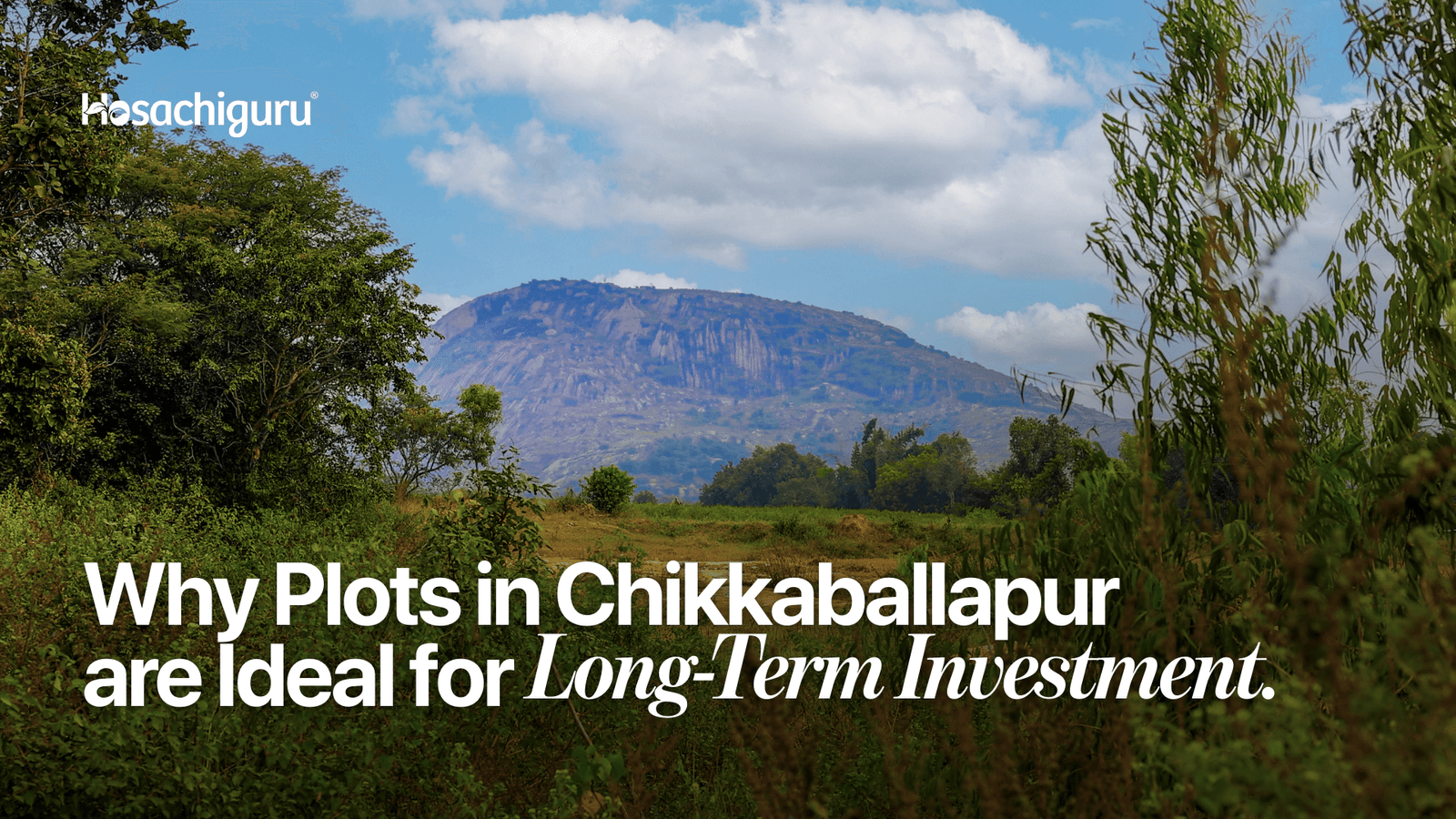
Chikkaballapur isn’t an empty canvas. It’s a functioning agricultural district. Soil here is active. Water movement still follows topography. Fruit trees, farms, and open tracts are not placeholders—they are productive systems.
This is the same underlying logic that defines successful managed farmland near Bangalore: land that continues to work even as ownership patterns evolve.
Hosachiguru’s managed farmland approach emerges directly from this reality. Instead of treating farmland as land waiting to be converted, it treats agriculture as a stabilising force—something that protects value while ownership and infrastructure evolve around it. As a managed farmland company, Hosachiguru anchors land value in productivity, not speculation.
Managed farmland thinking prioritises:
- Soil health as long-term capital
- Water planning before construction
- Land productivity alongside ownership
In a region already experiencing water stress, this approach isn’t philosophical—it’s pragmatic.
Unnati: a Farm-Themed Plot that Formalises Restraint
This thinking finds clear expression in Unnati.
Unnati is a farm-themed plotted development, structured around a deliberate 50–50 land-use concept:
- 50% of the land remains dedicated to growing—fruit orchards, green cover, and productive farmland
- 50% is allocated for building farm plots or homes
This is not a stylistic decision. It’s a governance decision.
By design, Unnati prevents overbuilding. It ensures that land continues to function—ecologically and economically—even as people build homes on it. The growing portion isn’t ornamental landscaping; it’s productive land, managed professionally in line with how a responsible managed farmland company would operate.
What this achieves over time is significant:
- Built spaces don’t overwhelm water systems
- Soil quality improves instead of degrading
- Open land remains economically useful, not just visually pleasant
- The land retains its rural intelligence even as lifestyles change
In Chikkaballapur, where unchecked development could easily strain resources, this 50–50 model aligns naturally with the land’s limits.
Regulation Quietly Supports this Approach
Chikkaballapur falls under the Chikkaballapur Urban Development Authority (CUDA), governed by Karnataka’s Town & Country Planning Act. The Master Plan defines land-use zones, setbacks, and development controls clearly.
The 2031 Master Plan earmarks over 55% of the planning area for residential use, signalling long-term housing growth—but not at any cost.
Only CUDA/DTCP-approved layouts with valid e-Khata titles are legally secure. Developments that respect land-use discipline, water planning, and zoning norms are far more likely to age well—financially and legally.
Farm-themed layouts like Unnati don’t work around regulation; they work with it. That alignment reduces future friction and makes ownership easier to sustain over decades.
How Chikkaballapur Compares, When Land Quality Is Factored In
Viewed purely through price, Chikkaballapur competes with Devanahalli, Doddaballapur, and North Bengaluru.
Viewed through land quality, it stands apart.
- Devanahalli is efficient, airport-driven, and increasingly dense
- Doddaballapur remains industrial-heavy with slower residential evolution
- North Bengaluru (Yelahanka, Hebbal) is mature and largely built out
Chikkaballapur still allows land to be both residential and productive—a characteristic increasingly associated with thoughtfully planned managed farmland near Bangalore. This makes plots in Chikkaballapur particularly attractive to investors who value longevity over immediacy.
Risks—and Why Farm-Led Planning Reduces Them
There are risks, of course. Infrastructure timelines can stretch. Social amenities will take time to develop. Water availability must be managed deliberately. Certain hilly or ecologically sensitive zones will remain restricted.
But farm-led, managed land models don’t ignore these realities—they design around them. They assume ownership will last decades. They limit overbuilding. They plan water first and construction second.
That mindset changes outcomes.
The Real Investment Thesis
Chikkaballapur is not a story about speed.
It’s a story about land that is allowed to remain productive while value accumulates.
Plots in Chikkaballapur—especially farm-themed developments like Unnati, shaped by Hosachiguru’s philosophy as a managed farmland company—offer something rare: land ownership that appreciates without exhausting the land itself.
For investors who understand that land rewards patience more than urgency, this isn’t a speculative play.
It’s a grounded one. And grounded land, more often than not, is what lasts.