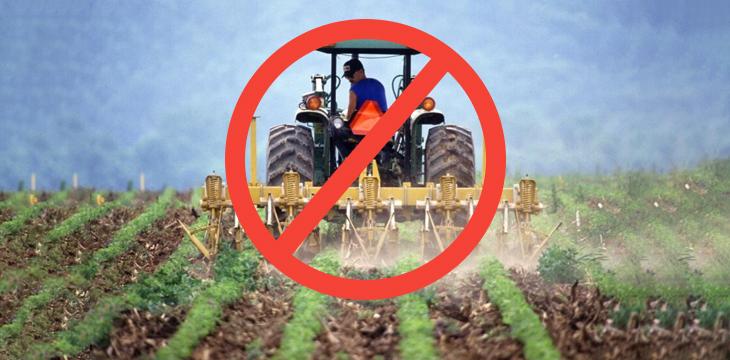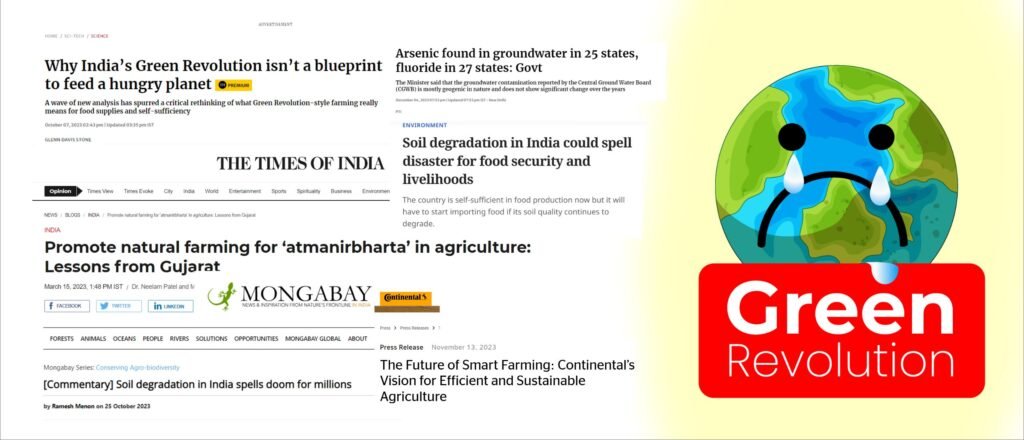
India’s Green Revolution: A Blessing or A Curse?

India’s Green Revolution: A Blessing or A Curse?

As we step back in time to India’s post-independence era, the 1950s were marked by significant changes. Our newly liberated nation adopted a Westminster-style parliamentary system of government at both the federal and state levels. However, the scars left by British colonial rule—ethics, wealth depletion, and reduced productivity—still lingered. With a population of 50.82 million citizens, India faced a critical challenge: how to feed its people with limited food grain production.

At that time, India heavily relied on importing food grains, particularly wheat, from the United States. The national reserves were depleting rapidly, and self-reliance and self-sufficiency seemed like distant goals. It was against this backdrop that a revolution in agriculture became imperative.

The Visionary Scientist: Mr. M.S. Swaminathan

Enter Mr. M.S. Swaminathan, an agricultural scientist who would play a pivotal role in reshaping India’s destiny. In 1953, during a meeting at the American Institute of Biological Sciences, he learned about newly developed genetically modified hybrid varieties of wheat. These varieties were remarkable—they responded well to external fertilizers and irrigation, resisted water lodging, and promised yields 2.5 times greater than native varieties.

From Trials to Nationwide Adoption: The Green Revolution Unfolds

Swaminathan’s journey began with small-scale trials across 114 districts. These trials introduced the High-Yielding Varieties (HYVs) of wheat and paddy. As their success became evident, the revolution expanded, covering the entire country. By 1965-66, the cultivable area for HYVs had grown from 1.89 million hectares to a staggering 72 million hectares by 2023-24 achieving a total food grain production capacity of 72 million tons in 1965-66 to 329 million tons in 2022-23 becoming one of the World’s top 3 exporters in food grains. 

It’s Impact: 

Before the Green Revolution, native farmers relied on indigenous seeds and followed diverse cropping systems—rice, millets, sorghum, maize, and barley. Rice and millets dominated their fields. However, the introduction of HYVs transformed the landscape. Rice and wheat took center stage, impacting the overall diet of the nation. The era from 1967 to 1968 witnessed an extensive and intensive transformation of agriculture, aptly termed the “Green Revolution.”  

1.Dependency on a Limited Set of Food Grains:

  • The Green Revolution significantly boosted the production of staple food grains, particularly rice, wheat, and maize.
  • While this led to increased availability of these grains, it also resulted in a heavy reliance on just a few crops.
  • Health Implications: Consuming predominantly rice and wheat can lead to health-related issues, as a diverse diet is essential for optimal nutrition.
  • Our culinary habits have also centered around these grains, limiting the variety of foods we consume.

2.Farmers’ Dependency on External Inputs:

  • Although India achieved self-sufficiency in food grain production, farmers now rely heavily on external inputs such as fertilizers, pesticides, and hybrid seeds.
  • Cost of Production: The increased use of these inputs has raised the cost of production for farmers.
  • Profit Realization: Despite higher yields, many farmers struggle to realize sufficient profits due to rising expenses.
  • In the past, farmers practiced integrated farming with diverse crops, which provided multiple income sources. The shift to monocropping has increased the risk of financial losses.

3.Depleting Water Tables:

  • The Green Revolution introduced water-intensive crops, leading to the expansion of advanced irrigation systems.
  • Unfortunately, little attention was given to recharging groundwater.
  • In regions like Haryana and Punjab, where the Green Revolution was implemented extensively, water availability is now a major challenge which has led to declining productivity over the past few years. 
  • World Bank Data: Approximately 63% of India’s districts face falling groundwater levels.
  • Poverty Impact: Poverty rates are higher in districts where groundwater tables have fallen below 8 meters, affecting small farmers disproportionately. 

The adverse effects of overexploitation, particularly in regions where intensive farming practices prevail. The need of the hour is a shift towards sustainable approaches that prioritize conservation while maintaining agricultural productivity.

  • Native crop varieties are less water-intensive and can significantly alleviate pressure on ground water resources. 
  • By diversifying crop selection, farmers can achieve a more balanced water usage pattern, promoting long-term sustainability.
  • Implementing strategies such as rainwater harvesting and artificial groundwater recharge can help restore aquifer levels, ensuring a reliable water supply for future generations.

4.Groundwater Pollution:

  • The intensive use of chemicals in agriculture—such as nitrates, sulfates, and heavy metals—poses a significant risk to groundwater quality.
  • When these chemicals are sprayed onto crops or soil, a substantial portion mixes with water and leaches down into the groundwater table.
  • Human Health Hazards: Contaminants like arsenic, nickel, copper, chromium, lead, mercury, and cadmium are associated with health issues, including cancer.
  • Given that 85% of India’s domestic water consumption relies on groundwater, this pollution directly affects human well-being.

5.Excessive Agro-Chemical Usage:

  • Every year about 62 thousand metric tons of Agro-chemicals are going to our Indian Soils just to control Pests and diseases.
  • But the harsh reality is that farmers often apply 70% to 80% more chemicals to their crops than necessary.
  • This excessive application of chemicals results in biomagnification, a process in which these substances progressively accumulate in the environment and organisms, posing serious health risks to ecosystems and human populations. 
  • The belief that “more chemicals mean more yield” has become a common refrain among farmers. However, it’s essential to strike a balance between productivity and environmental safety.
  • There is a global shift towards prioritizing chemical-free farming practices to align with the Sustainable Development Goals set to be accomplished by 2030. This emphasizes a move towards sustainable agricultural methods that minimize or eliminate the use of chemicals, promoting environmental health and long-term viability in farming systems worldwide.  

6.Deterioration of Soil Fertility:

  • Soil health is intricately linked to the presence of microorganisms—the unsung heroes of agriculture.
  • Unfortunately, excessive chemical use has harmed these beneficial microbes, affecting nutrient availability, soil structure, and plant growth.
  • The overapplication of external fertilizers, including NPK (nitrogen, phosphorus, and potassium) and micronutrients, disrupts the nutrient cycle.
  • Carbon Content Decline: Indian soil now contains less than 0.75% carbon in cropped areas. Carbon is crucial for plant growth—it’s the skeleton nutrient.
  • This reduction in soil carbon content raises alarms for future food security.

The Green Revolution had far-reaching effects, and it’s essential to consider its implications. Here are some individual steps we can take to create a positive impact for the future: 

Remember, individual actions collectively create a significant impact. By making conscious choices, we contribute to a healthier planet and a better future for all.

Latest Blogs

Hosachiguru Farm Showcase: See Real Land, Meet Real Farmers, Ask Real Questions

What to Expect from Villa Plot Developments Near Bangalore’s Airport in the Next 5 Years

Why Villa Plots Near Bangalore Airport Are Ideal for Vacation Homes

Privacy Policy

At Hosachiguru, accessible from https://www.hosachiguru.com/, one of our main priorities is the privacy of our visitors. This Privacy Policy document contains the types of information that are collected and recorded by Hosachiguru and how we use it.

If you have additional questions or require more information about our Privacy Policy, do not hesitate to contact us.

This Privacy Policy applies only to our online activities and is valid for visitors to our website with regard to the information that they share and/or collect in Hosachiguru. This policy is not applicable to any information collected offline or via channels other than this website.

Consent

By using our website, you hereby consent to our Privacy Policy and agree to its terms.
Information we collect

  • We will always make it clear to you what personal information we need and why we need it when we ask you to provide it. 
  • If you contact us directly, we may receive additional personal information about you, such as your name, email address, phone number, and any other information you choose to provide, including the contents of any messages or attachments you send us.
  • When you register for an Account, we may ask for your contact information, which may include your name, company name, address, email address, and telephone number.

How we use your information

We use the information that is collected in various ways, including:

  • To provide, operate, and maintain our website
  • To improve, personalize, and expand our website
  • To understand and analyze how you use our website
  • To develop new products, services, features, and functionality
  • To communicate with you, either directly or through one of our partners, including for customer service, to provide you with updates and other information relating to the website, and for marketing and promotional purposes
  • To send you emails
  • To find and prevent fraud
  • Log Files

Hosachiguru follows a standard procedure of using log files. These files log visitors when they visit websites. All hosting companies do this and are a part of hosting services’ analytics. The information collected by the log files includes internet protocol (IP) addresses, browser type, Internet Service Provider (ISP), date and time stamp, referring/exit pages, and possibly the number of clicks. These are not linked to any information that is personally identifiable. The purpose of the information is for analyzing trends, administering the site, tracking users’ movement on the website, and gathering demographic information.

When you voluntarily send us electronic mail, we will keep a record of this information so that we can respond to you. We only collect information from you when you register on our site or fill out a form. Also, when filling out a form on our site, you may be asked to enter your: name, e-mail address or phone number. Your data is confidential and will not be shared with any 3rd party. You may, however, visit our site anonymously. In case you have submitted your personal information and contact details, we reserve the rights to Call, SMS, Email or WhatsApp about our products and offers, even if your number has DND activated on it.

Cookies and Web Beacons

Like any other website, Hosachiguru uses ‘cookies’. These cookies are used to store information including visitors’ preferences, and the pages on the website that the visitor accessed or visited. The information is used to optimize the users’ experience by customizing our web page content based on visitors’ browser type and/or other information. For more general information on cookies, please read “What Are Cookies”.

Advertising Partners Privacy Policies

You may consult this list to find the Privacy Policy for each of the advertising partners of Hosachiguru.

Third-party ad servers or ad networks use technologies like cookies, JavaScript, or Web Beacons that are used in their respective advertisements and links that appear on Hosachiguru, which are sent directly to users’ browsers. They automatically receive your IP address when this occurs. These technologies are used to measure the effectiveness of their advertising campaigns and/or to personalize the advertising content that you see on websites that you visit.

Note that Hosachiguru has no access to or control over these cookies that are used by third-party advertisers.

Third-Party Privacy Policies

Hosachiguru’s Privacy Policy does not apply to other advertisers or websites. Thus, we advise you to consult the respective Privacy Policies of these third-party ad servers for more detailed information. It may include their practices and instructions about how to opt out of certain options.

You can choose to disable cookies through your individual browser options. To find more detailed information about cookie management with specific web browsers, it can be found on the browsers’ respective websites.

CCPA Privacy Rights (Do Not Sell My Personal Information)

Under the CCPA, among other rights,

Request that a business that collects a consumer’s personal data disclose the categories and specific pieces of personal data that a business has collected about consumers.

Request that a business delete any personal data about the consumer that a business has collected.

Request that a business that sells a   consumer’s personal data, not sell the consumer’s personal data.

If you make a request, we have one month to respond to you. If you would like to exercise any of these rights, please contact us.

GDPR Data Protection Rights

We would like to make sure you are fully aware of all of your data protection rights. Every user is entitled to the following:

Right to access – You have the right to request copies of your personal data. We may charge you a small fee for this service.

The right to rectification – You have the right to request that we correct any information you believe is inaccurate. You also have the right to request that we complete the information you believe is incomplete.

The right to erasure – You have the right to request that we erase your personal data, under certain conditions.

The right to restrict processing – You have the right to request that we restrict the processing of your personal data, under certain conditions.

The right to object to processing – You have the right to object to our processing of your personal data, under certain conditions.

The right to data portability – You have the right to request that we transfer the data that we have collected to another organization, or directly to you, under certain conditions.

If you make a request, we have one month to respond to you. If you would like to exercise any of these rights, please contact us.

Children’s Information

Another part of our priority is adding protection for children while using the internet. We encourage parents and guardians to observe, participate in, and/or monitor and guide their online activity.

Hosachiguru does not knowingly collect any Personal Identifiable Information from children under the age of 13. If you think that your child provided this kind of information on our website, we strongly encourage you to contact us immediately and we will do our best ‌to promptly remove such information from our records.

Contact Us