
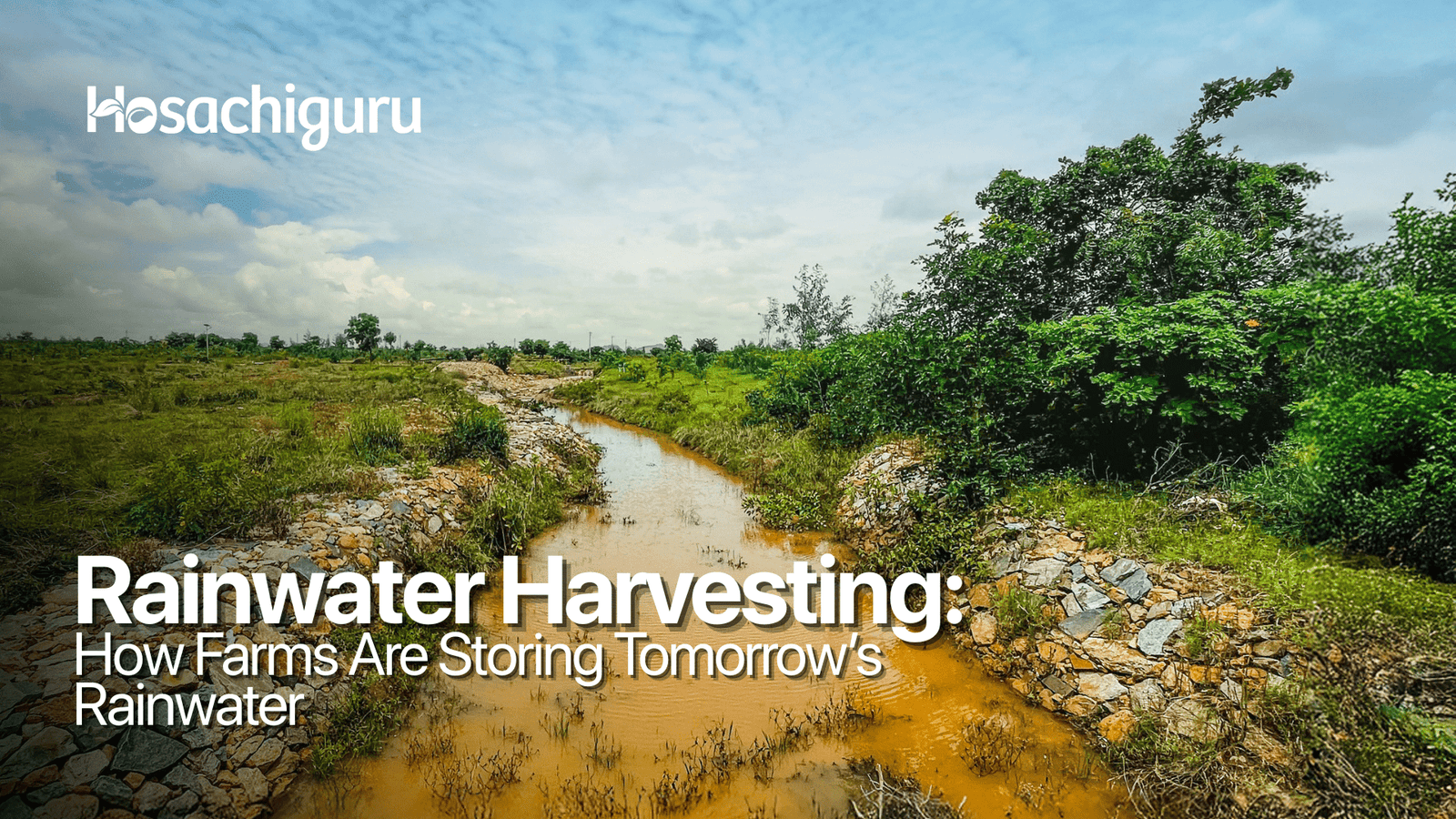
When rains fall on our lands, they do not belong to a pipeline or a corporation; they belong to the earth and all beings. For any managed farmland company, to harvest and utilise that rain is to honour our responsibility, to protect food sovereignty, and to resist the industrial logic that makes water a commodity.
Today, as climate breaks its rhythms and drought and flood weave into each other, the question is not whether to harvest rain; the question is how to do so in a way that restores the land, regenerates ecosystems, and returns agency to farmers. Far beyond engineering feats, rainwater harvesting on a managed farmland is a reclamation of water democracy. It is an act of self-reliance. It is food sovereignty in practice.
The Water Heritage of India: Tanks, Stepwells, Taankas
Long before chemical agriculture and giant pumps, India’s peoples wove water wisdom into the land. The tank (kalyani, pushkarni), especially in South India is not just a pond, it is a living water temple, a community cistern, a groundwater recharge source, or a seasonal store. In Rajasthan and Gujarat, the stepwell (baoli, vav, bawari) descends with steps that meet the receding water table: as the rains recede, the steps reach deeper, drawing groundwater and surface flow together in harmony. Researchers note that many stepwells are porous and linked to groundwater, allowing infiltration and storage, not just surface holding.
In desert lands, people built taankas, covered cisterns that capture rooftop and courtyard runoff, sealed to prevent evaporation, meeting drinking and micro-irrigation needs. And rural North India saw johads, community percolation ponds that recharge aquifers and supply water for cattle and fields.
Rainwater Harvesting on Farms: The Path to Regeneration
On a modern farm, especially a managed farmland, rainwater harvesting is not optional: it is foundational. We must capture, hold, filter, infiltrate, and release, always keeping the water in circulation, not letting it run off to drown or dry.
Core Techniques Farms Use
- Contour swales, staggered trenches, bunds, micro-catchments
By shaping the land, digging swales along contours, creating staggered trenches, bunds, rain is slowed, spread, and stored. This reduces erosion, encourages infiltration, and builds microclimates. - Recharge wells and pinhole infiltration
Beyond surface capture, water is guided into recharge shafts, pinholes in borewell casings, or underground tanks, to push water deep into aquifers.
- Storage tanks and ponds
On-farm ponds or ferrocement tanks collect runoff or diverted gutter flows. These act as buffer reservoirs for irrigation and livestock use.
- Drip/micro-irrigation fed by harvested rain
Captured water is wisely allocated through drip lines, so every drop meets plant roots with maximum efficiency.
- Mulching, cover cropping, soil organic matter
The more organic matter and cover on the soil, the more rain the soil holds. Farms invest in compost, mulch, groundcover to increase infiltration and reduce evaporation.
- Smart monitoring and control
Soil sensors, water-level sensors, and simple IoT tools help farmers know when to divert flows, when tanks are near overflow, and where water is most needed.
These techniques are ecological choreography. They reclaim water’s trajectory and return it to the land.
Challenges — And How Hosachiguru Navigates Them
Of course, there are challenges. But every challenge is a site of possibility, what matters is how we respond.
1. Capital and infrastructure costs
Building tanks, digging recharge shafts, creating swales, these cost money. Many small farmers lack the upfront capital.
- Hosachiguru, as a managed farmland project, pools resources and spreads the cost over many plots. The economies of scale of the project lets us invest in shared water infrastructure.
- In 2025 alone, Hosachiguru managed farmlands harvested and saved over 5 crore litres of water through rainwater harvesting, recharge ponds, and drip irrigation.
2. Site-specific hydrology and design
Wrong placement of trenches or bunds can backfire, water may bypass, erode, or stagnate.
- Hosachiguru’s team conducts contour surveys, soil and water flow studies, and designs swales, staggered trenches, bunds that follow the land’s memory.
- We use interconnected swales (e.g. in our Dhaanvi Farms on Kanakapura Road) so excess flows cascade safely.
3. Stagnation, contamination, mosquitoes
Open ponds or stored water can become breeding grounds.
- Hosachiguru minimizes this risk by maintaining water movement, filtration, and cover in ponds. We integrate riparian planting and buffer species that keep the edges alive.
- Because the managed farmland model supports maintenance through its team, these cleaning cycles are built in.
4. Water quality and siltation
Runoff may carry sediment, agro-waste, debris.
- First-flush systems, sediment traps, vegetative filters are part of the design.
- At Hosachiguru, we design riparian zones and vegetated margins to filter particulates before the water enters storage or recharge systems.
5. Social and knowledge gaps
Many farmers are not trained in RWH design or operation.
- The managed farmland structure of Hosachiguru allows training, shared knowledge, farmer workshops and extension. Owners of farm plots are often onboarded into this knowledge ecosystem.
- As a unified community, co-farmers can collaborate on maintenance and knowledge-sharing.
6. Seasonal extremes and overflow
Heavy monsoon pulses risk overflows and erosion.
- Proper spillways, buffer storage, cascade tanks, and overflow into recharge zones handle surges.
- Hosachiguru designs with safety capacity and multiple tiers of storage so that even in intense rain, water doesn’t escape but filters slowly downwards.
Through these strategies, challenges become invitations to deepen the resilience of soils, water, and community.
Rainwater Harvesting and Food Sovereignty
When farms control their water destiny, they reclaim food sovereignty. Food sovereignty is the right of people to define their own food systems, to grow for themselves rather than rely on distant, extractive supply chains. But without water, there is no agriculture, no sovereignty.
- Rainwater harvesting decentralizes water control; it means farmers are not slaves of borewells or corporate pipelines.
- It allows multi-plantation, pulse cultivation, vegetables, nutrition plants — not just water-demanding monocultures.
- It respects local ecology. Soil and water know their rhythms; rainwater harvesting works with those rhythms, not against them.
- Through such autonomy, communities regain control over seeds, crops, nutrition — free from the corporate logic that tells you what cash crop to grow.
In regenerating water, we regenerate health, community, dignity. From Ancient Wisdom to Regenerative Farms
The lineage of stepwells, tanks, taankas, johads sings in the land still. Regenerative agriculture, planting diversity, minimal disturbance, root systems, living soils, is the continuation of that wisdom, with modern awareness.
When a managed farmland is rooted in regenerative methods, rainwater
harvesting becomes integral, not add-on. On such lands:
- The soil is alive, full of microbes, organic matter, capable of absorbing water rather than repelling it.
- Deep-rooted trees and perennial systems draw water up and recycle nutrients.
- Systems like swales and recharge wells become part of the contours of agroforestry, orchards, food forest edges.
- Everything — water, carbon, soil, biodiversity — begins to circulate in cycles, not linear extraction.
“We are not just storing rainwater; we are restoring the water cycle.” Hosachiguru: Weaving Rain into Every Farm, Always Protected
Let us tell you about Hosachiguru’s vision and action, how we, through our managed farmland model, truly practice what we preach.
From the very beginning, we knew one simple truth: water is not guaranteed. So we built every farm on a foundation that honors and protects it. Rainwater harvesting became the backbone of our infrastructure.
Every farm plot under Hosachiguru is designed with rainwater harvesting-based irrigation and active borewell recharging as part of its core system. Across our projects, we dedicate nearly 15–25% of the land to water conservation — through ponds, swales, riparian zones, natural drainage lines, and open wells.
We even reintroduce collected rainwater back into the underground aquifers using pinholes in borewell pipes, helping raise groundwater tables over time. Swales, bunds, and staggered trenches hold back excess rain, maintaining surface moisture and reducing irrigation needs. Hosachiguru Dhaanvi’s network of interconnected swales stands as a living example of how cascade capture and reuse can transform a landscape.
Because we operate within a managed farmland system, our role doesn’t stop at design, we maintain, monitor, and adapt. We make sure ponds never stagnate, filters stay clean, margins are well-vegetated, and systems evolve with changing conditions.
In 2025 alone, we proudly harvested and saved over 5 crore litres of water across our managed farmlands through rainwater harvesting, recharge ponds, and a
carefully maintained drip irrigation network. It’s our defense against droughts. It’s how we ensure our farm plots stay protected, even when the skies don’t cooperate. When drought years come or monsoons delay, our farms still hold water. When neighboring borewells falter and rivers shrink, our soil moisture persists. We’re not dependent; we’re resilient.
Today, if you search for managed farmlands or farm plots for sale near Bangalore, you’ll find many options, but Hosachiguru stands apart with our dedicated commitment to water. Our farm plots come with not just secure ownership and ecological design, but also a water infrastructure that safeguards your agricultural future.
At Hosachiguru, we’ve shown that you can own land without owning risk, because water isn’t just part of our design; it’s part of our DNA.
A Call: Let Every Farm Be a Rain Bank
To our fellow farmers, landowners, and changemakers, let every farm become a rain bank. Let every contour and bund hold back life itself. When our water is secure, our food grows deeper roots, our soil breathes easier, and our communities endure.
Let us bring back the wisdom of our ancestors, the tanks, stepwells, and johads, and renew them through the lens of regenerative farming. Let our lands become living systems again, not production units. Choose land that is cared for, not abandoned to depletion. Choose managed farmlands that hold rain, restore balance, and nurture resilience.
At Hosachiguru, we live this truth each day — harvesting rain, reviving soil, and protecting farms from the droughts of tomorrow.
Because the future will belong to those who can hold the rain — not just on their land, but in their hearts.