
How Biodiversity Supports Sustainable Development: Key Insights for 2025
The Hidden Infrastructure of Survival: Biodiversity and the SDGs
The forest speaks in many tongues—wind through leaves, birdcall in the canopy, the murmur of water weaving its way through soil. These are not just sounds, but a language of interconnection. And in the quiet listening, we come to understand: life does not exist alone. It thrives in relationships.
On this International Day for Biological Diversity on May 22, 2025, under the theme “Harmony with Nature and Sustainable Development,” we are called to remember what our ancestors once knew—that we belong to the Earth, not the other way around. That the health of a forest, a wetland, or a coral reef is inseparable from our own well-being.
To live in harmony with nature is not merely a poetic notion—it is a practical necessity. Every breath we take, every meal we eat, every drop of water we drink is made possible by biodiversity. These myriad forms of life—from the microscopic fungi threading through soil to the great elephants shaping savannas—form the web that supports human life. They are not background scenery. They are kin.
Biodiversity: Our Food, Water & Medicine
We often speak of development as something separate from nature, as if progress must come at the cost of the wild. But this is a false choice. Biodiversity is not a barrier to development; it is the very basis of it. Consider the Sustainable Development Goals (SDGs) laid out by the United Nations—zero hunger, good health, clean water, climate action. Not one of these is achievable without a thriving diversity of life.
Food security, for instance, is not only about plantations and yields. It’s about the pollinators that fertilize our orchards, the wild plants that hold genetic traits essential for plantation resilience, and the rich tapestry of soil organisms that keep our lands fertile. Each time a species disappears, we lose a unique strand in the tapestry—an ingredient that may one day heal or feed us.
Clean water—the essence of life—depends on ecosystems that filter, store, and regulate it. Forests capture rainfall and recharge aquifers; wetlands cleanse runoff and buffer floods. Yet, across the world, we are draining, paving, and poisoning these systems. When we degrade watersheds, we sever the veins through which life flows. The SDG for clean water (SDG 6) is only attainable if we protect the biodiversity within these landscapes.
And then there is health. More than half of modern medicines are derived from plants, fungi, and animals. Aspirin from willow bark. Cancer drugs from the Madagascar periwinkle. These are gifts from wild relatives, not synthetic miracles. We often marvel at technological breakthroughs, but forget that biotechnology itself stands on the shoulders of evolution’s billions of years of research. Every species lost may carry a compound that could save lives or unlock the next medical revolution. As E.O. Wilson warned, “The loss of biodiversity is the folly our descendants are least likely to forgive.”
Hosachiguru : Farming for the Future
Climate change, too, is deeply entwined with biodiversity. Forests are among our greatest allies in the fight against warming—they capture carbon, regulate rainfall, and stabilize temperatures. Healthy ecosystems act as buffers against floods, droughts, and storms. But these systems must be whole to function; fractured landscapes cannot protect us. Climate action (SDG 13) and life on land (SDG 15) are bound by this truth: resilience lies in richness.
So how do we move from destruction to restoration? How do we make space for wildness while feeding and sheltering ourselves?
One answer lies in reimagining our relationship with land. At Hosachiguru, a collective of earth stewards working across southern India, this vision takes root in the soil—literally. Our managed farmlands are designed not only to produce food but to regenerate ecosystems. Here, the principles of permaculture and agroforestry shape a landscape where trees and crops grow in harmony, where birdsong returns, and the earth heals.
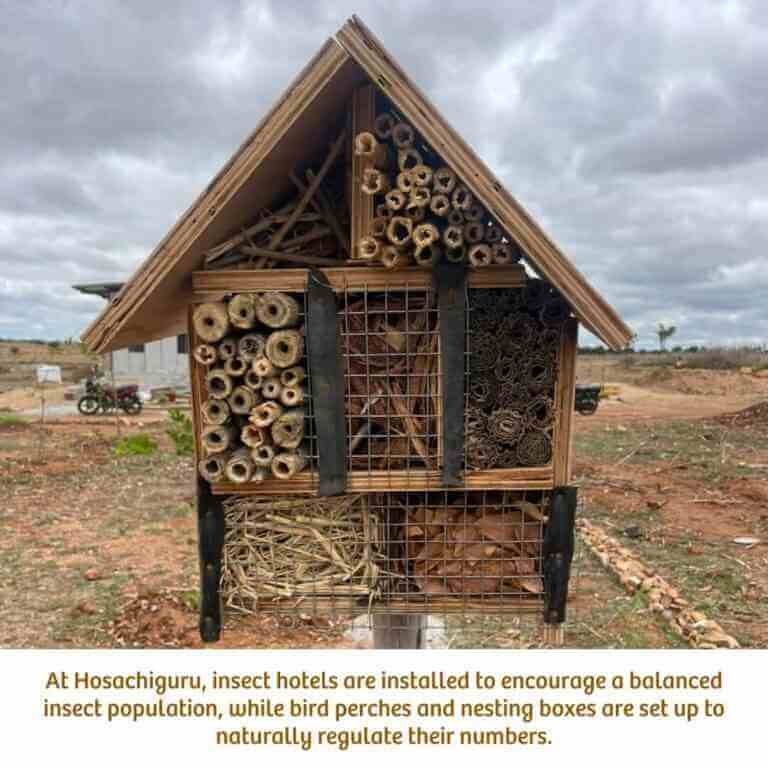
We build bird habitats—perches for raptors, feeders for seed-eaters, and nesting boxes for insect-loving songbirds like chickadees and swallows. These birds help control pests naturally, reducing the need for harmful chemicals. Our farms also combat invasive species, protecting native flora and fauna by planting native and heirloom varieties, they attract local pollinators and preserve genetic diversity. In this way, agriculture becomes an ally of conservation, not its adversary.
Water management is treated as sacred. Through the use of swales, trenches, and riparian buffers, Hosachiguru ensures that every drop of rain is cherished—soaking into the land, replenishing aquifers, and sustaining life.
Our practice of regenerative agroforestry creates layered landscapes rich in plant and animal life. Spiraling gardens, habitat ponds, and hedgerows become sanctuaries for bees, butterflies, dragonflies—and for wonder.
But perhaps the most vital restoration is that of soil. Healthy soil teems with life: bacteria, fungi, earthworms, nematodes—all working in concert to cycle nutrients and store carbon. Hosachiguru nurtures this hidden world through no-till farming, composting, and mulching. In doing so, we foster the conditions for biodiversity to thrive from the ground up.
Speaking Earth’s Language, Living Its Wisdom
None of this happens in isolation. People are part of the ecosystem, not apart from it. When local communities benefit economically from thriving biodiversity—through sustainable harvesting, eco-tourism, or payments for ecosystem services—they become its fiercest protectors. Development aligned with conservation becomes not only possible but powerful.
We often ask: What can I do? The answer is not only in grand gestures but in the daily choices to restore, protect, and listen. To teach our children the names of birds. To let a patch of garden grow wild. To demand policies that honor the living Earth.
Because every species is a story. Every habitat is a library. And as we lose them, we lose not just beauty, but knowledge, medicine, stability—and possibility. As Robin Wall Kimmerer reminds us, “To be native to a place, we must learn to speak its language.” And the language of the Earth is biodiversity—complex, interwoven, sacred.
Let us learn to speak it again.
Sustaining biodiversity is sustaining life, for all of us.
Isn’t it ironic how we tirelessly chase success in bustling cities, only to long for a breath of fresh air and a touch of nature to truly unwind?
This yearning isn’t just a fleeting escape—it’s a deeper call for balance, a reminder of the simple yet profound joys that nature offers. Managed farmlands answer this call, providing not just tranquility but a path to a more meaningful, wellness-oriented lifestyle.
When we speak of wellness, we mean more than just physical health; it’s a harmonious blend of mental, emotional, social, and environmental well-being. At the core of this balance lies one powerful factor—food.
How and where your food is grown profoundly impacts your overall wellness.
Let’s delve into how managed farmlands foster a healthier lifestyle.
-
Access To Safe Food
A study by the Environment Management and Policy Research Institute (EMPRI) uncovered alarming levels of heavy metal contamination in vegetables across Bengaluru. Out of 400 samples analyzed from 20 locations, vegetables like beans, spinach, and coriander exceeded the FAO’s permissible iron limits of 425.5 mg/kg. Shockingly, beans recorded 810.20 mg/kg, spinach 554.58 mg/kg, and coriander 945.70 mg/kg. This contamination stems from synthetic fertilizers and pesticides used to accelerate growth.
At managed farmlands, we prioritize soil health through organic practices, using natural fertilizers like cow dung and plant-based nutrients. By avoiding harmful chemicals, the produce is free of contaminants, packed with nutrients, and boasts a 20–30% longer shelf life—a win for health and sustainability.
-
Improved Mental & Physical Health
Physical and mental health are two sides of the same coin—when your body feels good, your mind follows suit. And at the core of this harmony lies food and nature.
A wholesome, plant-based diet brimming with vibrant colors isn’t just a treat for the eyes; it’s a game-changer for health. Even global bodies like the WHO emphasize that such diets can significantly lower the risk of chronic conditions like kidney disease, cancer, and even depression.
But it doesn’t stop at food. Stepping into the great outdoors boosts natural killer cell production by up to 50%, lowers cortisol, and melts away stress. Together, nourishing food and nature pave the way for physical vitality, mental clarity, and emotional resilience.
-
Foster Community Connections
In today’s digital age, where human connections often feel fragmented, the power of community remains vital for our well-being. Managed farmlands offer more than lush greenery—they become vibrant hubs of togetherness, where people from all walks of life come together to nurture the land and grow sustainable food.
These farms foster a sense of belonging through workshops and events that educate and inspire. From hands-on sessions about organic farming to discussions on sustainability, they provide opportunities to learn, share, and connect. Beyond growing food, they cultivate meaningful relationships and shared experiences, creating a space where the community thrives, and individuals rediscover the joy of collaboration and purpose.
-
Building A Sustainable Future
Sustainability lies at the core of managed farmlands, transforming them into more than just spaces for growing food—they’re catalysts for eco-friendly living. These farms champion practices like organic farming, rainwater harvesting, renewable energy use, and waste recycling, creating a harmonious balance between nature and human needs.
By embracing these initiatives, individuals don’t just nurture the land; they actively participate in environmental conservation. It’s a lifestyle that seamlessly integrates personal well-being with the planet’s health. Beyond the tangible benefits of clean, sustainable produce, managed farmlands offer a profound connection to nature, fostering a sense of purpose and responsibility.
-
Instilling Values in the Next Generation
Children naturally emulate what they see in their parents. When families immerse themselves in nature, embrace sustainable farming, savor fresh organic produce from their own land, and take a break from the digital world, children absorb these values effortlessly. Managed farmlands become more than a retreat—they transform into living classrooms.
Here, children gain hands-on experience with sustainability, understanding the value of hard work, and discovering the wonders of the natural world. These experiences plant seeds of eco-consciousness, cultivating future leaders who respect the environment and strive for a positive impact.
Conclusion
Access to healthy food is often determined by where you live. In fast-paced cities like Bangalore, with a population nearing 14.4 million in 2025, the convenience of unhealthy, quick options becomes all too tempting, leaving health to take a back seat.
Managed farmlands offer more than just a real estate investment—they represent a lifestyle choice rooted in health, community, and sustainability. These spaces provide a sanctuary where wellness and environmental responsibility come together, creating a balanced life. In a world that increasingly values harmony with nature, managed farmlands showcase the powerful benefits of living in tune with the earth.
Could the future of real estate be rooted in the soil? What if the land you lived on provided both a peaceful retreat and the food on your plate?
Introducing Hosachiguru Unnati, our first farm-themed villa plots located just 45 minutes from Bangalore International Airport, near Chikballapur. This one-of-a-kind development beautifully combines the serenity of farm life with the conveniences of modern living, letting you savor the charm of Old Bengaluru while creating your dream villa.
At Unnati, expansive green spaces provide the perfect playground for your children to explore, learn, and grow, all while surrounded by fresh air and lush landscapes. Enjoy nature walks, bike rides, or even grow your own organic food for a healthier, sustainable lifestyle. Rooted in permaculture principles, our community is built on caring for the Earth, people, and fair sharing.
With scenic hills, a moderate climate, and excellent connectivity via NH44, Unnati is also Vastu-compliant and offers amenities like camping, bonfires, a swimming pool, and sports courts. Embrace a lifestyle where nature and community come together in perfect harmony!
Farm Themed Villa Plots: The Future Of Real Estate
Hosachiguru Unnati is where lush greenery, eco-friendly practices, and urban conveniences come together in perfect harmony. At Hosachiguru Unnati, real estate is redefined, with a future that’s greener than ever. Here, sustainability isn’t an afterthought—it’s the foundation.
- Each villa plot is equipped with advanced water management systems that ensure water is used wisely and replenished effectively.
- Why settle for high-maintenance lawns when you can have a flourishing ecosystem in your backyard? At Unnati, we prioritize growing native species, which are not only beautiful but also low-maintenance and perfectly suited to the local climate.
- Edible landscaping brings the farm to your doorstep, creating a self-sustaining lifestyle where beauty meets bounty.
- Each villa plot at Unnati comes with around 15 trees, an investment in the future that stands in stark contrast to the concrete jungles of today.
- Unnati offers modern conveniences without sacrificing comfort—RERA-approved (RERA No: PRM/KA/RERA/1251/446/PR/190924/007045) villa plots ensure transparency and security, giving you the confidence to invest in your future.
- With access to a clubhouse for social gatherings and advanced sewage treatment plants that reduce environmental impact. It blends sustainability with luxury.
It offers a lifestyle that doesn’t compromise on either, providing the best of both worlds. Unnati isn’t just the next step in real estate—it’s the future.
Villa Plots Inspired By Permaculture Principles
Permaculture, meaning permanent agriculture or culture, is a holistic approach to creating self-sustaining ecosystems that mimic the harmony of nature.
At Unnati’s farm themed villa plots, this philosophy forms the foundation of our design, ensuring a resilient, self-sustaining environment that benefits all life forms. Instead of working against nature, permaculture embraces the efficient use of resources like water, energy, and waste, where nothing goes to waste.
Unlike traditional landscapes, it encourages diverse ecosystems by growing a variety of plants and animals that support each other in a balanced way. Native species and companion planting are key at Unnati, enhancing both the beauty of your surroundings and the health of the environment.
Imagine living amidst edible landscaping—where fruit trees, vegetables, herbs, and medicinal plants thrive, offering organic, homegrown produce right from your garden.
Our villa plots also feature pollinator-friendly spaces, filled with wildflowers and herbs that attract butterflies, bringing vibrant life and aroma to your home; and let you grow seasonal herbs, vegetables, or flowers, and can even double as creatively play areas for children.
With self-sustaining systems like food forests and natural pest controls, your garden will flourish with minimal effort. By planting trees and conserving water, Unnati’s permaculture practices not only create a sustainable home but actively help combat climate change.
Catering To Every Chapter Of Life
Retirement Home
Retirement isn’t just about slowing down; it’s about staying active and embracing the joys of life. Why hit pause when you can hit refresh? From a peaceful walk through the garden to a calming outdoor yoga session, there’s always a way to keep moving. As we grow older, we naturally seek simpler pleasures—like maintaining our health, spending time with loved ones, and enjoying a tranquil lifestyle. At Unnati, it’s all possible—think of it as trading traffic noise for the soothing soundtrack of nature. Surrounded by nature, your new neighbors include trees, flowers, and maybe even a squirrel, making this the retirement home you’ve always dreamt of.
In this nurturing environment, community becomes your extended family, helping you feel connected and valued. Regular interactions keep the mind sharp—think of it as mental yoga! And at our farm themed villa plots, you can even grow your own food where your grandkids will love picking fresh fruits straight from the trees.
Mindful Parents
Children are eager for endless adventures and the freedom to explore nature—it’s their personal wonderland. From planting seeds to watching them grow, children get a hands-on learning experience that teaches them about lifecycles, responsibility, and the simple joys of farming. It’s education that’s both fun and delightfully muddy!
By trading screen time for sunshine, they learn to grow their own potatoes instead of just being couch potatoes. It’s also a perfect way to spend quality time with family, digging together and creating memories that will last a lifetime. Along the way, they’ll become little eco-heroes, learning composting, recycling, and water conservation while feeling like they’re saving the planet.
With bare hands in the soil, their creativity blossoms as nature stimulates all five senses—sight, sound, smell, taste, and touch. Free from strict schedules, their minds are free to wander, sparking new ideas.
As a mindful parent, encouraging a green lifestyle instills values of sustainability and environmental stewardship, ensuring they carry those lessons into the future.
Pet Parents
At Unnati, pets enjoy wide open spaces and exclusive areas where they can run, play, and explore freely—no cramped yards or apartment living here! This freedom encourages physical activity, essential for their health and happiness. Surrounded by greenery, trees, and gardens, our farm-themed villa plots allow pets to tap into their natural instincts—sniffing, exploring, and connecting with the world around them.
- Designed with pet safety in mind, our edible landscapes feature native plants and avoid harmful pesticides, so pets can safely roam and enjoy the environment.
- Our pet-friendly community attracts nature lovers and pet owners alike, fostering a sense of camaraderie and connection. With shared open spaces where pets can socialize, Unnati creates a welcoming environment for both animals and their humans.
- Here, life close to nature ensures pets stay active, healthy, and happy, with every day feeling like an adventure.
Unnati is more than just home—it’s a paradise for pets and their owners alike.
Eco-Conscious Individuals
Investing in farm-themed villa plots is like giving nature a big hug.
Imagine growing your own dinner, with a fresh salad bar right in your backyard. These villa plots provide ample space to cultivate organic veggies, herbs, and fruits, ensuring every meal is homegrown and delicious.
- We encourage edible landscaping, where 50% of the plot is dedicated to creating gardens with native plants that attract pollinators and support local wildlife.
- Sustainable living is built into the design with rainwater harvesting systems and smart irrigation techniques like the Bhungroo system, ensuring every drop of water is put to good use.
- Recharging wells helps boost groundwater levels, keeping both your garden and the community green and healthy.
- You can also generate clean energy with solar panels making sustainability a lifestyle.
Plus, it’s the perfect setup for composting, turning kitchen scraps into rich soil to nourish your garden naturally.
Adventure Seekers
Villa plots offer a refreshing escape from ordinary city life, allowing you to embrace breathtaking landscapes and thrilling adventures. With nearby attractions to Hosachiguru Unnati like Varlakonda Fort and Skandagiri, there’s always something unique to experience.
- Varlakonda Fort Trek combines adventure with nature, perfect for birdwatching and capturing stunning photographs.
- If you’re feeling adventurous, Skandagiri’s famous night trek leads you through forested trails to witness a mesmerizing sunrise above the clouds.
At Unnati, cozy evenings with family and friends under the stars are enhanced by camping, bonfires, and warm community gatherings. You can also cultivate new skills like outdoor cooking, gardening, or building a dream treehouse—endless adventures await right in your backyard!
Discover The Luxuries Of Nature: AWE Factor
Air
Air is the invisible force that sustains all life, and Hosachiguru’s managed farmlands, agroforests and food forests work to enhance both the environment and weather. These natural havens act as carbon sinks, purifying the air while serving as physical barriers to pollutants. The result is a space where trees, plants, and open landscapes create a natural symphony that cleanses the air. Breathing here isn’t just a necessity—it’s a gift, carrying the scent of rain-soaked soil and fresh leaves in the breeze. Every breath is a reminder of this precious, invisible luxury.
Water
Water is the lifeblood of nature, and at Hosachiguru, it’s at the heart of our design. Through smart land and water management practices like rainwater harvesting, swales, trenches, and bunds, we capture rainwater to naturally recharge the groundwater and borewells, making the farms self-sufficient over time. Unlike the processed water of the city, the water here is fresh, pure, and abundant nurturing both the land and those who live on it. Flowing straight from the earth, it is not just water here, it is the purity itself, a reflection of the untouched world around it. Here, water is not just refreshing – it is life giving, in the truest sense.
Earth
Earth is sustained by an unseen army of soil, providing the foundation for all life. At Hosachiguru, we prioritize the longevity of this vital resource through regenerative practices like mulching, vermicompost, and microbial cultures. These efforts have led to a 10-fold increase in the soil’s organic carbon content over the past 8-10 years. There’s something luxuriously grounding about walking barefoot on rich, fertile soil, a unique experience our farm-themed villa plots offer. This land doesn’t just support your home—it nurtures your soul, offering space to plant, grow, and dream, connecting you to something timeless and elemental.
Conclusion
At Hosachiguru Unnati, we’re not just offering farm themed villa plots; we’re presenting a transformative lifestyle where nature, community, and sustainability intertwine. With over a decade of experience, we’re like the wise old trees, rooted in sustainability and ready to nurture your dreams!
Our dedication is reflected in over 25 successful projects and the satisfaction of more than 1,600 happy co-farmers who have embraced this unique way of living. With impeccable legal scrutiny and a strong focus on creating self-sustaining ecosystems, Hosachiguru Unnati is designed to enhance your quality of life.
So, why settle for a concrete jungle when you can have a green kingdom? Join us in this revolutionary approach to real estate, where the luxuries of nature—clean air, pure water, and fertile earth—become part of your everyday life.
The ability to grow food forms the bedrock of human civilization. Imagine if we were still hunters and gatherers, spending every waking moment hunting and foraging for food—we would never have had the time or opportunity to build a civilization. Humanity’s transformation began with the discovery and understanding of plant life, learning to harness its potential. This shift marked the evolution from hunter-gatherers to creators and innovators, capable of shaping the world around us. It was only through the cultivation and storage of food that we could focus on exploring aspects of life beyond mere survival, enabling the growth of culture, science, and society as we know it.
India’s agricultural history spans an extraordinary 15,000 years. Few countries, apart from some in South America, can claim such a deeply rooted connection to farming. Agriculture has been central to the evolution of civilizations, and India’s success in this realm stems from unique and favourable conditions. The country is blessed with fertile soils, a wide latitudinal and longitudinal range, over 300 days of abundant sunlight each year, and an extensive network of rivers and water bodies. Most importantly, Indian farmers have historically exhibited a profound ability to observe and connect with the rhythms of life and nature. These factors have enabled farmers in this region to master agricultural practices, from their earliest beginnings to their most advanced forms.
After the Green Revolution, many farmers worldwide began to recognize the harmful effects of synthetic fertilizers and chemicals on human health, soil quality, and the environment. This led some to transition back to traditional and sustainable farming methods. Natural Farming, at its core, involves cultivating crops without synthetic fertilizers, pesticides, herbicides, tillage, weeding—hence the term “do nothing.” However, this philosophy refers to working with nature rather than imposing artificial control over it.
What is Natural Farming?
Natural Farming is an ecological approach of growing plants without intervening in or altering their natural life processes through the usage of synthetic chemical inputs or artificial methods.
Masanobu Fukuoka, a Japanese farmer and philosopher, is considered the pioneer of Natural Farming. He introduced the term in his groundbreaking book “The One-Straw Revolution”, published in 1975. Natural Farming is also referred to as “the Fukuoka Method,” “the natural way of farming,” or “do-nothing farming.” Despite the term, it does not imply that the farmer does nothing; rather, it emphasizes minimal intervention. The farmer’s role is to nourish and support plants, allowing them to thrive and produce flowers and fruits naturally.
Principles of Natural Farming
1. No Tillage
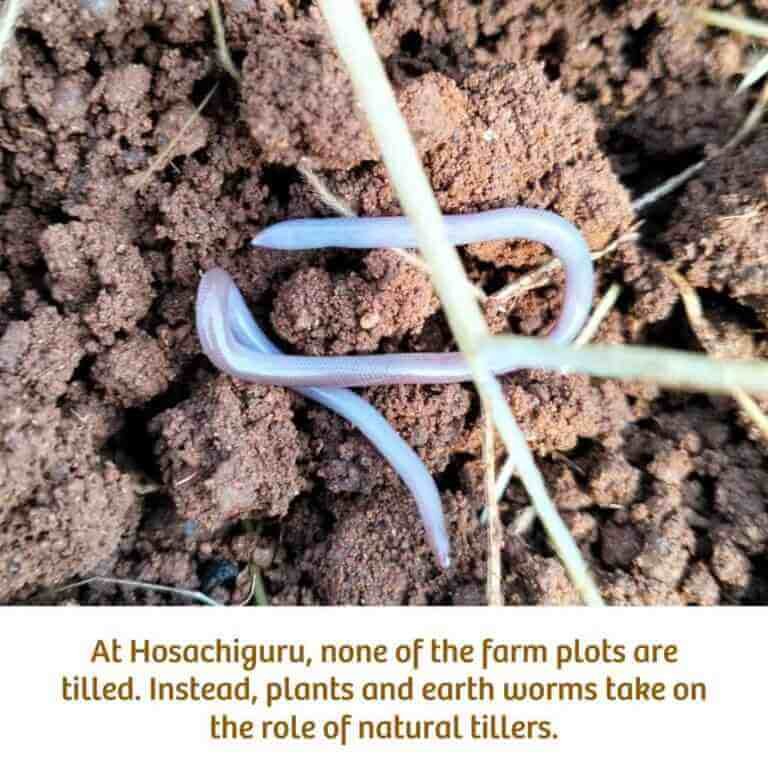
Tillage is typically performed to loosen the soil, improve aeration, and mix manure or organic waste before sowing seeds or transplanting the saplings. However, nature performs this process effortlessly. Trees naturally loosen the soil through the growth and movement of their root systems. Worms create tunnels as they move through the soil, enhancing aeration. Birds dig for worms, while insects and animals create holes and burrows for nesting. Organic matter also contributes by holding moisture and maintaining aeration, keeping the soil loose and fertile.
2. No Fertilizers
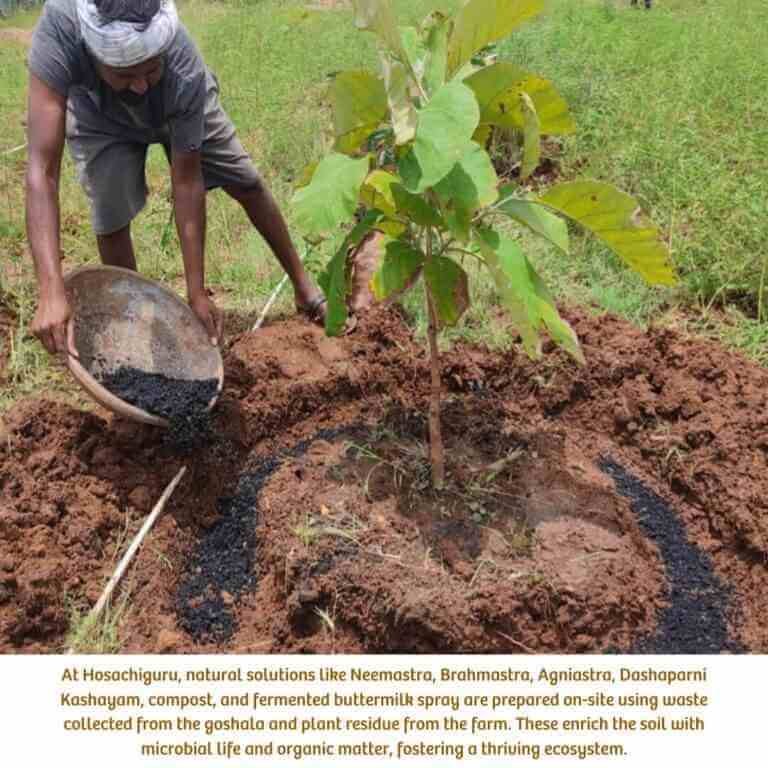
Most fertilizers available in the market are predominantly chemical based. While only a fraction of the fertilizer provides nutrients, the rest comprises toxic substances. When synthetic fertilizers are applied to the soil, they disrupt and destroy life forms, including worms, insects, birds, animals, and vital microbial life. Over time, the soil loses its moisture content, microbial diversity, organic matter, and humus, eventually turning into barren land and, ultimately, sand.
3. No Weeding
Weeds play an essential role in enhancing soil fertility and maintaining the balance of the biological community. As a core principle of Natural Farming, weeds should be managed rather than eradicated.
There are two primary methods to control weeds:
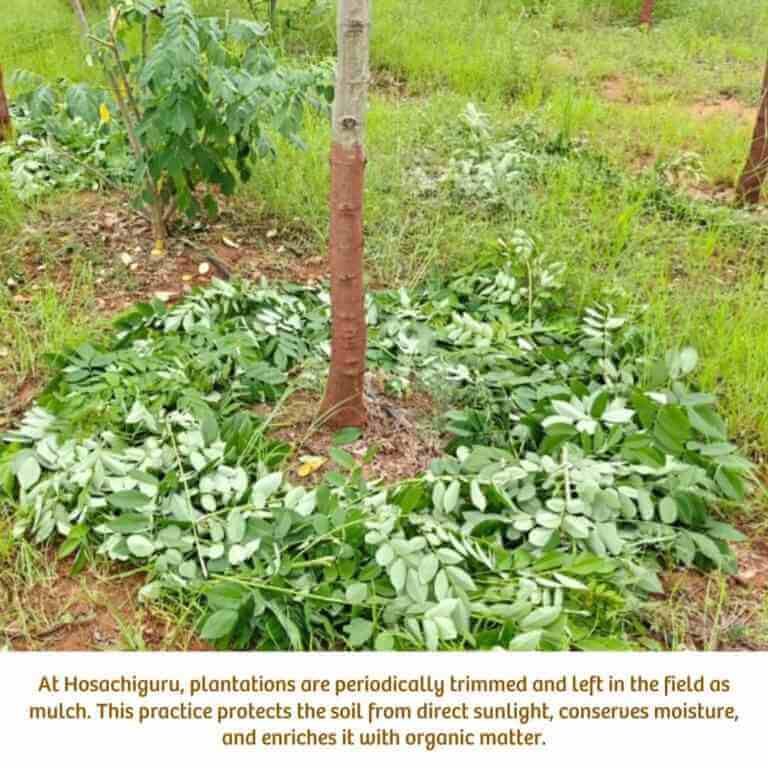
Using live mulch – This involves planting cover crops to keep the soil alive and protected.
Using dried plant matter as mulch – Branches, twigs, leaves, and other plant residues are used to cover the soil.
4. No Pesticides
At Hosachiguru, natural farming techniques are strengthened by the use of organic astras such as Neemastra, Brahmastra, Agniastra, Dashaparni Kashayam, and fermented solutions. These natural preparations are made using farm-based resources like neem leaves, cow urine, plant residues, and fermented plant extracts. They serve as effective pest management solutions, protecting crops without disrupting the ecological balance.
These astras work by repelling harmful pests, inhibiting their reproduction, and enhancing plant immunity, while being safe for beneficial insects like pollinators and soil dwellers.
In natural farming, the aim isn’t to eradicate pests but to manage their activity by fostering biodiversity. Many insects labeled as pests are integral to the ecosystem, contributing to organic matter breakdown, pollination, soil aeration, and turning. When vegetation is removed due to excessive ploughing or de-weeding, these insects lose their habitat and food sources, often resorting to feeding on crops.
Hosachiguru adopts a balanced approach to disease and pest control by cultivating resilient crops in a biodiverse environment. By maintaining this harmony and using these astras, we ensure that both plants and their surrounding ecosystem flourish, emphasizing sustainability over short-term fixes.
5. Biodiversity
Biodiversity is a cornerstone of Natural Farming, as it minimizes imbalances and vulnerabilities in the environment.
Natural farmers avoid monoculture practices, as cultivating a single crop can disrupt the ecosystem, making it more susceptible to diseases, viruses, and pest attacks. Instead, balance is achieved by growing a diverse array of plants and trees, tailored to their purpose—whether for fodder, fruits, flowers, medicine, timber, or seasonal crops. This diversity can be incorporated through intercropping or mixed cropping methods.
Crop rotation further supports biodiversity by managing soil nutrients and fostering the growth of seasonal crops, ensuring sustainable agricultural practices.
6. Native Seeds
Native seeds play a vital role in preserving local biodiversity by maintaining a wide range of plant varieties that have naturally adapted to thrive in specific ecological niches over time. These native varieties are easy to grow, rich in life energy and nutrition, and possess a strong immunity that helps them resist and combat pests, viruses, and even survive in harsh climatic conditions.
In contrast, hybrid varieties are engineered for specific purposes, such as maximizing yield or meeting market and consumer demands. By using native seeds, farmers promote seed sovereignty, empowering them to save, exchange, and use their own seeds. This practice protects biodiversity and reduces dependence on external seed sources.
Native seeds preserve traditional agricultural practices and the cultural heritage associated with specific crops. They support the continuation of indigenous knowledge in seed saving, crop management, and sustainable farming methods. Native plants are often more water-efficient, having evolved to thrive in local conditions with limited water availability. This is especially crucial in regions facing water scarcity, contributing to more sustainable water management. Additionally, native seeds are adapted to local nutrient cycles, reducing the need for external fertilizers.
7. Minimum 30% of the Land should be Cultivated with Trees
Trees play a crucial role in restoring ecological balance and providing economic benefits to farmers. They help re-establish balance in farmlands by offering habitats for animals, providing shade for the land, holding rainwater, and recharging groundwater. Trees also prevent soil erosion, reduce runoff, mitigate flooding, create organic matter, and contribute to humus formation. Additionally, they absorb atmospheric carbon and help mitigate local weather extremes.
Natural farmers rely on their own farm inputs to create concoctions, manures, and mixtures. Trees provide essential resources for farmers, including seasonal fruits and vegetables, firewood, shelter, flowers, timber, medicinal plants, fodder, rubber, gum, resin, fiber, and many other valuable products.
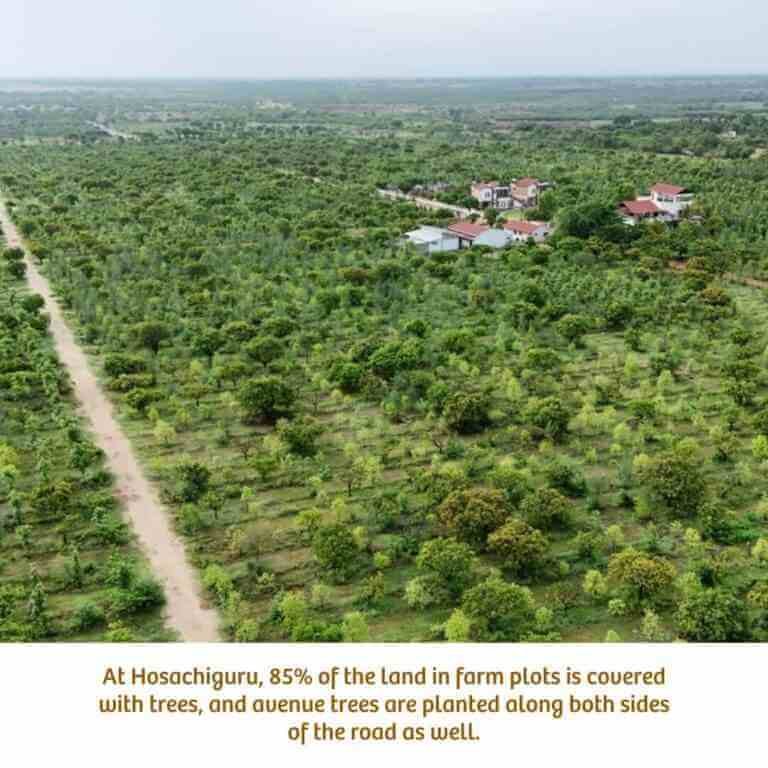
8. Adopting Local Farm Animals such as Cattle, Buffaloes, Birds, Horses, Donkeys etc.
Farm animals are an integral part of natural farming, and it is nearly impossible to do natural farming without them. Farm animals are involved in every stage of farming, from ploughing to harvest, and they can even serve as draft animals for tasks such as ploughing fields, transporting goods, and performing physical labour. Even today, in many parts of the world, animals continue to be used for draft power, particularly in subsistence farming operations.
One of the quickest ways to enrich the soil is through animal waste. Animals contribute significantly to soil fertility through grazing and manure deposition. Grazing animals help break up soil compaction, improving soil structure, while their manure adds valuable organic matter and nutrients, enhancing soil fertility and productivity.
9. Watersheds Should be Part of Every Farm or Village
A watershed is an area of land where all the water drains to a common point, such as a stream or river, lake, or pond. Watersheds serves as catchment area for rainwater, often utilized for irrigation and consumption, reducing dependence on external water sources.
In natural farming, water problems and irrigation challenges are addressed by enriching the soil with organic matter. Organic matter can retain more water than the watershed itself, which significantly reduces irrigation requirements. Watersheds also play a key role in regulating runoff water, preventing soil erosion, and minimizing nutrient loss.
Watersheds support diverse ecosystems by providing habitats for a variety of plant and animal species. As water moves through the watershed, it undergoes natural filtration processes, improving water quality and making surface water available for animals.
Since watersheds often extend beyond individual farms, effective management requires cooperation at the community level. Natural farming encourages collaboration and community engagement to promote sustainable water use and conservation.
Conclusion
Natural Farming is a regenerative approach inspired by Masanobu Fukuoka’s philosophy, which emphasizes working with nature rather than against it. Fukuoka’s “do-nothing” farming advocates minimal intervention, relying on natural processes to cultivate resilient crops and nutrient-rich food. Key principles include no-tillage, native seeds, organic composting, and fostering biodiversity, which together enrich the soil and create thriving ecosystems.
At Hosachiguru’s managed farmlands, these principles come to life. Practices such as using natural astras, intercropping, planting diverse native trees, and conserving water through swales and watersheds embody our commitment to ecological harmony. By adopting Fukuoka’s approach, we focus on enhancing soil health, reducing dependency on external inputs, and creating self-sustaining ecosystems.
Hosachiguru integrates these time-tested methods with modern techniques to redefine farming, nurturing biodiversity, promoting sustainability, and ensuring a healthier, more balanced future for people and the planet.
In India, there is a profound understanding of the cosmos and its impact upon life on the planet. This deep awareness led to the creation of the lunisolar calendar, with festivals designed as tools to help life blossom to its fullest potential. There was a time in India when entire 365 days of the year were celebrated as festivals for every aspect and activity of life.
Sankranti is one such festival that reminds us of kite flying, bonfires, harvest celebrations, Surya Pooja (worship of the Sun), farm animals, and much more. While commonly known as a harvest festival, but there is more to it than the harvest. Sankranthi is also known as Uttarayana or Makara Sankranthi. Although the festival is celebrated with a different name in each part of the Indian Subcontinent, but the essence behind the celebration is the same science. The term Makara refers to Capricorn in the zodiac movement, signifying a celestial movement. Sankranti means transition or movement, marking the beginning of the solstice.
The Science Behind Seasons and Sankranti
Seasons on Earth occur due to its elliptical orbit around the Sun. If Earth moved in a perfect circular orbit, there would be no seasonal changes. Around December 22nd, the winter solstice takes place, meaning the northern hemisphere of Earth begins to tilt closer to the Sun for the next six months. The opposite occurs in the southern hemisphere. This transition triggers a burst of life in the northern hemisphere, manifesting in the form of fruits, flowers, insects, animals, and various other life forms.
From Sankranti onwards, the harshness of winter gradually diminishes. This change brings new possibilities in how we experience life. It is also the time when farmers harvest their crops and plan for the next sowing season. As the harvest is gathered, grand celebrations follow. Farm animals, essential to agriculture, are honored during this time with various festivities. Farmers gather to plan future crops and assess the health and fitness of their animals, determining whether they are fit to continue work or need retirement.
Cosmic Geometry and Energy
Energy is the source of the existence. Life on Earth has formed and evolved through three fundamental energy forces which are solar, lunar, and cosmic forces.
The human body, for instance, contains 72,000 energy pathways. Among these, there are 114 energy junctions (nadis) where multiple energy pathways converge. These junctions are non-physical and cannot be identified by dissecting the body. Out of the 114, 112 are within the human physiology, while 2 exist outside it. Of the 112, 108 key energy junctions play a significant role in how we experience life and maintain energy levels.
The geometry of the cosmos reflects this energy alignment. For instance:
- The diameter of the Sun is approximately 108 times the diameter of the Earth.
- The distance between the Sun and Earth is about 108 times the Sun’s diameter.
- Similarly, the distance between the Moon and Earth is approximately 108 times the Moon’s diameter.
The Significance of Solar Energy
Solar energy drives life on the planet. The Sun’s cycles span roughly 12.5 years, while the Moon’s cycles are about 29.5 days. The lifespan of heirloom grape varieties is typically 14 to 28 days. However, sun-drying these grapes can extend their shelf life to three years or more.
This transformative power of the Sun is also evident in those who practice Sun Salutations (Surya Kriya). Regular practice is believed to enhance vitality, often leading to a lifespan close to 100 years, with individuals remaining strong and energetic until their final moments.
Harnessing Solar Energy Through the Body
There are many ways to activate solar energy within the body, but the most effective method is through Sun Salutations. This practice activates the solar plexus, creating a vibrant energy form of the Sun within one’s system. While techniques like sungazing and sunbathing can help to some extent, they pale in comparison to the potency of Sun Salutations. As the fire element increases in the body, it reduces food intake and the need for sleep significantly.
Festivities and Their Purpose
During this time of year, life in the northern hemisphere slows down due to the reduced radiant energy of the Sun. To counteract this, festivals like Sankranti were designed with activities such as kite flying, bonfire, lighting oil lamps, and serving sesame sweets, activities for farm animals, which could generate heat in the body and keep life moving.
Sankranti: A Celebration of Movement and Stillness
Sankranti is the festival of celebrating the movement, not only of Sun but of the very Life process. The only way to truly experience movement is through stillness.
This Sankranti, embrace the festival of movement and stillness by bringing the Sun back into your life.
“We know more about the movement of celestial bodies than
about the soil underfoot.”
— Leonardo da Vinci
Soil is often overlooked, yet it forms the foundation of life on Earth. It’s more than just a mix of sand, silt, and clay—it’s an intricate ecosystem that sustains plants, animals, and humans alike.
Soil doesn’t form overnight; it is a gradual process shaped by time and nature. The formation of a single inch of fertile soil can take hundreds to thousands of years. It is the result of an extraordinary process where rocks slowly weather and organic matter accumulates through the decomposition of plants and animals. Over time, these elements meld into a complex and life-giving mixture that consists of:
- Mineral Particles: Sand, silt, and clay, which provide structure and texture.
- Organic Matter: Humus, a rich, dark material that serves as fuel for microbial life and enhances soil fertility.
- Living Organisms: A hidden world teeming with trillions of microbes, fungi, bacteria, nematodes, and worms that continuously break down organic material, cycle nutrients, and aerate the soil.
(Fun Fact: A single teaspoon of healthy soil contains up to 10 billion living organisms. That’s more living beings than the total number of humans on Earth!)
The Essential Contributions of Soil
1. The Carbon Cycle’s Key Player
A Carbon Reservoir: Soils store 2,500 gigatons of organic carbon, more than the atmosphere and all living plants and animals combined.
Collaboration with Plants: Through photosynthesis, plants absorb carbon dioxide and transfer carbon into the soil, where microbes and organic matter hold it.
2. Agriculture’s Unsung Hero
Food Production: Soil supports 98-99% of the calories humans consume, making it indispensable for global food security.
Erosion and Decline: Soil is eroding at alarming rates; 33% of Earth’s soil is degraded due to erosion, compaction, acidification and nutrient depletion.
3. A Climate Change Mitigator
Carbon Sequestration: Healthy soils act as massive carbon sinks, capable of reducing atmospheric CO2 levels. Soil holds six times more carbon than all the plants and animals on Earth combined.
4. Nature’s Water Filter
Hydrological Benefits: Soil can hold up to 20 times its weight in water, helping to prevent floods, sustain water supply during droughts, and filter contaminants.
5. Human Health Contributor
Immune Booster: Exposure to soil microbes strengthens our immune systems and promotes mental well-being by releasing stress-reducing chemicals like serotonin.
The Environmental Toll Of Plowing
For over 12,000 years, human ingenuity has been reshaping the natural world. Practices such as deforestation, agriculture, and urbanization have fundamentally altered soil ecosystems, often at a significant environmental cost. Among these transformative innovations, the plow stands out—a tool that revolutionized farming but inadvertently became a silent contributor to climate change.
By turning over carbon-rich soil layers, the plow exposed stored organic carbon to the air, accelerating its decomposition and releasing billions of tonnes of carbon dioxide into the atmosphere. While it enabled large-scale agriculture and helped sustain growing populations, this process has steadily drained the soil of its fertility, leaving it less capable of supporting future generations.
The Challenges of Soil Degradation
Erosion and Fertility Loss: The thinning layer of topsoil threatens our ability to grow food for a projected 10 billion people by 2050.
Wetland Loss: Since 1997, the world has lost 250 million acres of wetlands, which are critical for soil and water health.
Urbanization: Expanding cities and infrastructure further depletes soil resources.
Why We Must Protect Soil
Food Security: Without healthy soil, feeding a growing population becomes impossible.
Climate Resilience: Soil helps combat extreme weather by retaining water and storing carbon.
Ecosystem Stability: Soil supports life, from the smallest microbes to the tallest trees.
Soil Health: A Regenerative Revolution
This world soil day, as the spotlight falls on the theme of “Caring for Soils,” Hosachiguru is proud to showcase a remarkable milestone in sustainable agriculture. Over the past three years, we’ve achieved an outstanding over 100% increase in organic soil carbon content, reflecting our unwavering commitment to regenerative soil management.
Through the meticulous analysis of over 300 soil samples, we observed a significant rise in soil organic carbon levels, from 0.25% in 2022 to 0.6% in 2024. This achievement underscores the transformative impact of our innovative practices designed to rejuvenate the land and foster long-term ecological health.
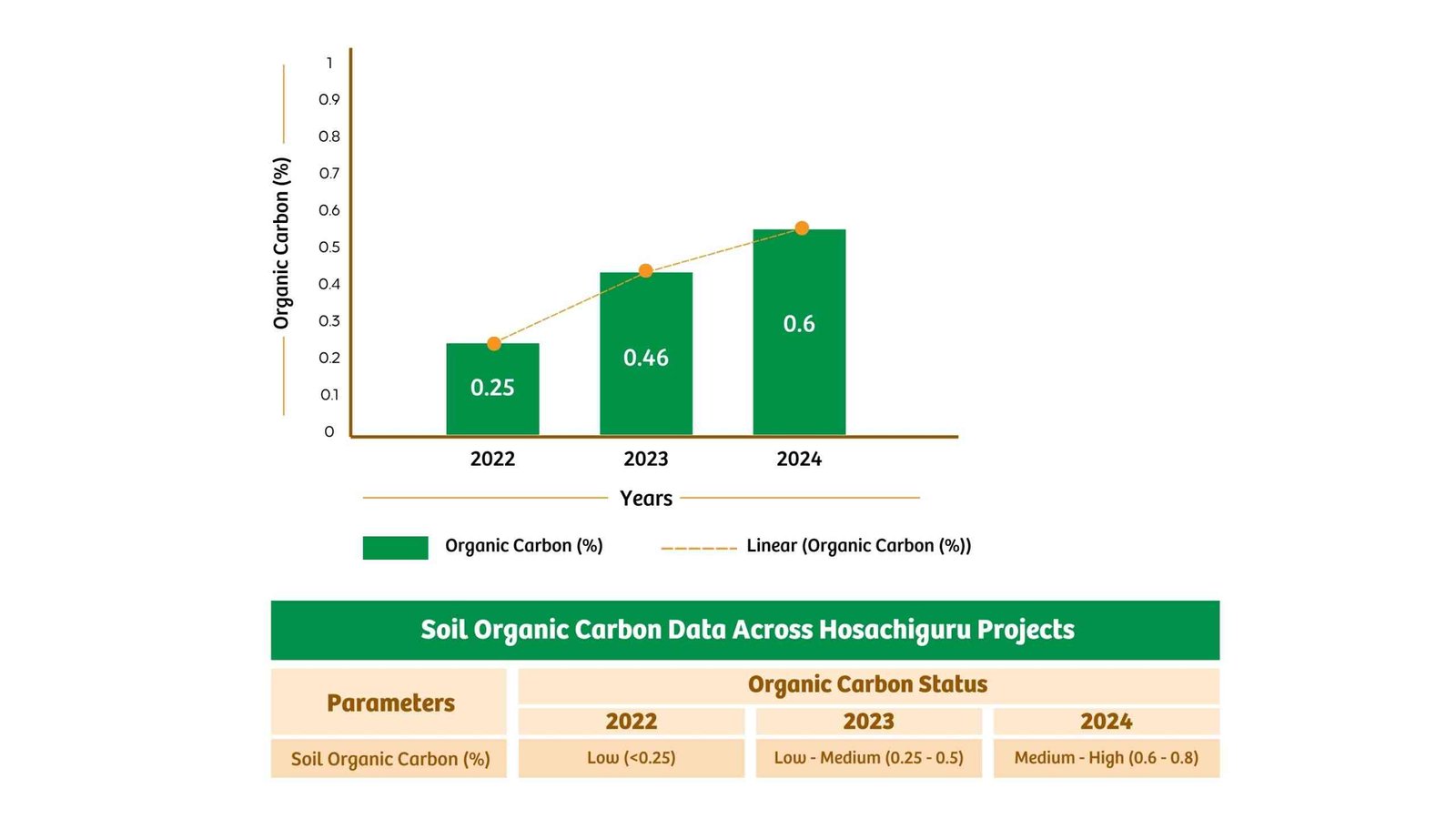
At Hosachiguru, we’ve implemented a holistic approach to soil care by embracing techniques such as mulching, no-till farming, using in-house organic solutions, and planting biomass trees. These regenerative methods not only enhance soil fertility but also:
- Boost biodiversity, creating thriving ecosystems beneath the surface.
- Strengthen resilience, enabling soils to withstand climate challenges.
- Improve soil structure, forming a stable foundation for future agricultural prosperity.
This upward trend exemplifies the tangible benefits of nurturing the soil, ensuring its vitality for generations to come. As custodians of the land, we remain steadfast in our mission to build a sustainable future, one enriched by the symbiotic relationship between humanity and nature.
The soil’s story is ours to shape—let’s nurture it today to preserve this invaluable treasure of gold.
Author: Anmol Agarwal
Read Time: 7 mins
“The greatest threat to our planet is the belief that someone else will save it.”
— Robert Swan
Anxiety has become a defining challenge of our time, especially for younger generations. A survey of 10,000 youth found that over half believe humanity is doomed, three-quarters feel afraid of the future, and more than one in three are unsure about having children. Many fear they might be the last generation—but they don’t have to be. Instead, this could be the generation that leads the world toward sustainability.
Sustainability means meeting the needs of today without compromising the future. While our ancestors lived sustainably to some extent due to smaller populations, their progress came at a high environmental cost. More energy meant burning fossil fuels, and more food required expanding farmlands at the expense of forests. However, technology is now enabling us to separate growth from environmental harm, offering new ways to thrive without sacrificing the planet.
To move forward, we must reduce carbon emissions, phase out fossil fuels, and end deforestation—all while feeding a growing population. But sustainability shouldn’t be framed as a burden or sacrifice. Too often, environmental efforts focus on scarcity, asking people to cut back and live minimally. This narrative limits how we imagine the future.
Instead, sustainability is an opportunity—one that offers clean, accessible energy for all, freeing communities from the unpredictability of fossil fuels. It’s about breathing cleaner air and designing cities and communities that serve both people and nature. Sustainability challenges us to rethink how we live and build, offering the freedom to create a healthier, more resilient world. We are not the last generation—we could be the first to build a sustainable future.
Future-proof the planet; act sustainably now!
The Hidden Journey of Waste: Does Recycling Really Make Sense?
There is no such thing as “away.” Every time we throw something out, it still goes somewhere. For example, did you know that 15,000 disposable cups are produced every second? Recycling might seem like a solution, but the reality is complicated. Whether something is recyclable, whether it actually gets recycled, or whether recycling it even makes sense, often yields different answers. Mixed messages have made recycling confusing, leaving many of us wondering what the right thing to do really is.
To be clear, recycling is important—we absolutely need to recycle more. Learn what your local waste service accepts and recycle properly. But recycling alone won’t solve our addiction to waste. Growing up, many of us were taught the three R’s: reduce, reuse, and recycle. Yet for decades, we’ve focused too much on recycling—the last step in the hierarchy. We need to shift our mindset to producing and consuming less in the first place. Here are simple ways to embrace sustainable living:
- Buy fewer, higher-quality items that last longer.
- Shop second-hand for clothing, furniture, and electronics.
- Carry reusable bags, bottles, and containers to avoid single-use plastics.
- Incorporate more plant-based meals into your diet.
- Use LED lighting to save energy.
- Limit water use with shorter showers and low-flow fixtures.
- Harvest rainwater for outdoor activities.
- Download media instead of streaming repeatedly.
- Switch to natural cleaners like vinegar and baking soda.
- Choose products with minimal or eco-friendly packaging.
Small changes can make a big difference. When we rethink our habits, we move from managing waste to preventing it altogether.
The three R’s aren’t just letters; they’re a pecking order. Start with reduce!
The Secret Life of Dirt: Why Soil is the Real MVP?
Have you ever stopped to think about how your food is produced? More importantly, is this production in harmony with the limited resources of our planet? Earth is home to 8 billion people, and by 2050, that number will rise to 10 billion, driving up food demand by 70%. But here’s the alarming truth: if we continue exploiting our resources at the current rate, we could face severe food shortages within 30 years. This isn’t just a challenge for future generations—it’s a crisis we need to confront now.
What’s wrong with today’s agriculture? In recent decades, agriculture has intensified to meet growing demand. High-yield crop varieties have helped, but these crops lack nutrients, as well as drain essential nutrients from the soil. To replenish these nutrients, farmers rely heavily on synthetic fertilizers and pesticides, which contaminate soil and groundwater and harm biodiversity.
But the most overlooked part of this story lies underground. Beneath our feet is a hidden, thriving world—one we rarely consider. A single teaspoon of soil contains as many organisms as there are humans on Earth, up to 10 billion organisms, contributing to 25% of the planet’s total biodiversity. These microscopic organisms play essential roles in maintaining life on Earth, driving critical biochemical cycles that regulate the global climate.
For instance, soil microbes produce greenhouse gases like carbon dioxide but also help consume methane, counteracting the effects of climate change. Microbes also recycle nutrients, making them accessible to plants and promoting healthier crops. Some microbes can even convert atmospheric nitrogen into plant-usable forms, providing the equivalent of 100 million tonnes of nitrogen fertilizer annually. Without them, we’d need to double our synthetic fertilizer use just to maintain current agricultural output.
Beyond fertilization, these tiny organisms help plants withstand environmental stresses like drought, extreme temperatures, and floods—essential support in a warming world.
It’s time we recognize the unseen heroes beneath our feet. Soil biodiversity plays a fundamental role in sustaining our ecosystems, yet human activities threaten to degrade this precious resource. As consumers and as a society, we need to protect and value soil biodiversity. By shifting toward sustainable practices, we can ensure that this vital ecosystem continues to support life for generations to come.
The invisible world beneath us is not just dirt—it’s the foundation of our future.
Hosachiguru’s Eco Elixir for Sustainable Farming
At Hosachiguru, we cultivate more than just plantations; we nurture a sustainable future through thoughtful practices on our managed farmlands. Here’s how we make a difference:
- We give our soil the care it deserves by covering it with a protective layer of mulch. This natural blanket locks in moisture, suppresses weeds, and fosters a thriving ecosystem beneath the surface.
- We’re committed to no-till farming, where the soil remains untouched. This approach boosts soil health, prevents erosion, and sequesters carbon, creating a more sustainable, resilient farming system.
- Our composting process gets a boost from nature’s best recyclers—worms! These little workers break down organic waste, turning it into vermicompost, a nutrient-packed fertilizer that enriches the soil naturally.
- We feed our plants with Jeevaamrutam, a nutrient-rich, all-natural tonic made from traditional ingredients. This plant superfood enriches the soil, introducing essential nutrients and beneficial microbes to keep it thriving.
- We add biochar, a carbon-rich material, to our soil to enhance its nutrient-retention capabilities. Biochar acts like a sponge, soaking up nutrients and water, and providing long-term health benefits for the soil.
- Our farms are equipped with swales, shallow trenches designed to capture rainwater. These water-harvesting structures recharge groundwater and keep our soil hydrated, even during dry seasons.
- We grow fast-growing trees in our biomass plantations, providing a renewable source of fuel while enriching the soil with organic matter, improving its health and structure.
- Restoring riparian zones and conserving wetlands is a key priority at Hosachiguru. These natural areas help rejuvenate ecosystems, reduce erosion, and improve water quality, supporting both the environment and our farms.
- We embrace companion planting, strategically pairing plants that support each other’s growth, naturally repel pests, and enhance biodiversity for a healthier, more balanced farm ecosystem.
- Our focus on planting native species ensures our crops are perfectly suited to the local environment. These resilient varieties are more water-efficient, better adapted to the climate, and help boost overall farm sustainability.
At Hosachiguru, our commitment to sustainability goes beyond farming techniques to fostering a community of passionate co-farmers. Neependra Khare, a dedicated member of our Dhaanvi Farm family, exemplifies this spirit by growing 70% of his family’s food on his own land, cultivating a variety of vegetables such as bottle gourd, spinach, tomatoes, brinjals, and American sweetcorn.
His approach to farming embraces natural practices, using neem oil for pest control and companion planting with marigolds to keep bugs at bay. These efforts align perfectly with Hosachiguru’s principles of nurturing healthy soil and building a sustainable future. Neependra’s journey is a heartening example of how our co-farmers are not just growing crops but also cultivating a resilient, eco-friendly lifestyle for generations ahead.
Conclusion:
On this Sustainability Day, let’s commit to actions that will secure a healthier, more resilient planet. Whether through sustainable farming, reducing waste, or conserving resources, each step we take today brings us closer to a future where growth and harmony with nature coexist. This is our moment to rethink how we live, consume, and protect our world, and remember sustainability is not a burden, but an opportunity to innovate and thrive.
Save the planet—because there’s no Planet B!
Author – Anmol Agarwal
Read Time – 7 mins
Imagine standing before two rooms. Room A is in complete disarray—littered with plastic bottles, broken items, and rotting vegetable scraps. The air feels heavy, and the clutter is overwhelming. Now picture Room B—a sanctuary of cleanliness and order. Everything is neatly arranged, surfaces gleam, and the air is fresh. Given the choice, you’d instinctively pick Room B, drawn to its cleanliness and tranquility. We all naturally gravitate toward environments that are tidy, organized, and pleasant.
We take pride in keeping our living spaces tidy, but why don’t we extend that same care to our neighborhoods and the Earth—the home we share daily? Maintaining a spotless room means little if we step outside and add to the litter polluting our environment. The Earth is more than just a home; it’s essential to our survival, and the waste we generate doesn’t disappear—it accumulates and harms the entire planet.
World Cleanup Day, observed on the third Saturday of September, was born from this concern. In 2008, 50,000 Estonians united to clean up their country in just five hours, sparking a global movement that continues to inspire people worldwide to protect and restore the planet.
The Alarming Reality of Waste and Misconceptions That Fuel It
Did you know that the average person consumes 70,000 microplastics each year? Or that we generate around 40 million tonnes of electronic waste globally every year—that’s equivalent to discarding 800 laptops every second. These statistics are staggering, aren’t they?
One of the key reasons for the excessive accumulation of waste around us is the common misconceptions we hold about it.
Misconceptions Fueling Waste Accumulation
Myth: All Plastics Are Recyclable
Many believe all plastics can be recycled, but not all types are recyclable, and the process depends heavily on local facilities.
Myth: Composting Is Only for Gardeners
Composting is often seen as a gardener’s task, but it’s a practice everyone can and should adopt. It significantly reduces landfill waste and curbs greenhouse gas emissions.
Myth: Recycling Is the Ultimate Solution
While recycling is important, it’s not the most effective solution. Reducing and reusing are far more impactful as they prevent waste from being created in the first place.
Myth: Waste Segregation Is Too Complicated
Waste segregation might seem daunting, but with basic education, it becomes a simple yet powerful way to reduce pollution and promote recycling. Segregation starts at every individual.
Myth: Biodegradable Equals Environmentally Friendly
Not all biodegradable items are eco-friendly. Compostable products, however, break down into non-toxic components, making them a safer option.
Myth: All Organic Waste Can Be Composted
Though composting is beneficial, not all organic waste is suitable. Items like meat and dairy can attract pests and cause odor, so the process becomes complex.
Myth: Waste Disappears After Collection
Many think waste simply vanishes once collected, but it often ends up in landfills, incinerators, or recycling centers, each with significant environmental consequences. Incineration, for instance, releases harmful pollutants, making it a less sustainable option.Myth: Landfills Are Harmless
Landfills are far from benign; they pose serious environmental risks, including groundwater contamination and the release of toxic gases.
Myth: Waste Segregation Isn’t My Responsibility
Some believe that waste segregation isn’t their problem or that small items don’t matter. However, individual actions are critical to effective waste management and reducing pollution.
We at Hosachiguru understand our role in maintaining hygiene around us and we are committed to responsible waste management, first by reducing the inputs. Then by recycling all waste from our farms and actively involving our community in these efforts. This pledge reflects our dedication to a sustainable future, ensuring that our actions positively impact the environment and support those around us.
To strengthen this commitment, we have partnered with Hasiru Dala Innovations, a renowned organization focused on eliminating waste and empowering waste pickers through innovative and inclusive business models. Together, we will implement responsible waste management practices across our farmlands and educate our staff and Co-Farmers on the importance of reducing, reusing, and recycling.
As our farms grow, this collaboration ensures that we maintain sustainable practices, minimize our environmental impact, and promote a healthier ecosystem. We also urge all our visitors to take any non-biodegradable materials back to the city for proper disposal, as it is our shared responsibility to keep our farms and the planet clean.
Along with this we practice the concept of Zero Waste that centers around the 5Rs: Refuse, Reduce, Reuse, Repurpose and Recycle, which, when applied to agriculture, foster a sustainable and efficient farming system that minimizes waste and promotes environmental health.
Refuse: Avoid synthetic fertilizers and pesticides, opting for organic alternatives from plants and animals to protect soil and water.
Reduce: Minimize resource consumption and waste generation; maintaining biodiversity helps keep soil fertile and reduces chemical use.
Reuse: Repurpose organic waste, such as crop residues and manure, as compost or mulch, enriching soil nutrients and boosting productivity.
Repurpose: Repurpose plastic containers into reusable materials such as for growing young plants in nursery.
Recycle: Compost organic materials to create nutrient-rich soil, enhancing soil structure, water retention, and microbial activity, leading to sustainable farming, and practice water recycling through rainwater harvesting.
Declutter Your World: Embrace the ‘Make Room for Life’ Movement.
Mahatma Gandhi once said, “Sanitation is more important than Independence,” a statement that holds profound significance. While he dedicated his life to fighting for freedom, Gandhi recognized that without cleanliness, the very foundation of independence is compromised.
Even research supports this, revealing that cluttered and unsanitary environments can overwhelm our visual cortex, leading to mental confusion and reduced focus. Sanitation, therefore, is not just a personal responsibility but a communal one that reflects our interconnectedness. While independence emphasizes individual freedom, sanitation honors the collective, ensuring that everyone can enjoy their autonomy in a clean, healthy environment. This balance between personal freedom and communal responsibility is essential for upholding the true spirit of independence and building a thriving society.
World Cleanup Day is a powerful global movement that unites people across borders, cultures, and even conflicts to address the global waste crisis. It highlights the collective strength we possess when we come together for a common cause. This year’s campaign, “Make Room for Life,” encourages us to declutter not just our physical spaces but also our lives.
The campaign emphasizes that cleanliness goes beyond the physical—it’s about clearing away the waste, pollution, and distractions that stifle our ability to fully embrace life. Just as a cluttered room hinders creativity and freedom, a polluted world suffocates life’s potential for growth and joy.
“Make Room for Life” invites us to reflect on what we’re holding onto that no longer serves us. By participating in World Cleanup Day, we’re not just cleaning our surroundings—we’re liberating ourselves and the planet from the burdens of excess and neglect. This act of renewal helps restore the environment’s natural beauty, creating spaces where life can thrive.
Ultimately, the campaign reminds us that true living requires space—space to grow, dream, and connect. By living with intention, we create environments that nurture life’s vitality, ensuring that our legacy is one of beauty, hope, and sustainability.
“By decluttering our planet and our lives, we make room for what truly matters—health, harmony, and a future where both people and nature can thrive.”
Author – Anusha Bilimagga
Read Time – 5 mins
Imagine waking up each day, surrounded by the comforts of your home. Every object you touch, from the toothbrush in your hand to the food on your plate, plays a role in your daily routine. But have you ever paused to consider where these materials go once, they’ve served their purpose? The reality is the waste we generate—both degradable and non-degradable—affects more than just our immediate surroundings; it impacts the world we share with countless other beings.
According to the Municipal Solid Waste Management Rules (2016), solid waste includes everything from domestic trash to commercial and institutional waste, street sweepings, and even construction debris. What we often forget is that waste is not just a problem to be dealt with by municipal authorities—it’s a responsibility we all share.
We live in a world of convenience, where the impulse to buy and consume is ever-present. But what if we took just a moment to think before making that purchase? Imagine how much waste we could prevent if we asked ourselves, “Do I really need this?” every time we reached for something new.
The Impact of Our Choices
Consider your home, a place of comfort and peace. Now, picture it filled with litter, plastics, and hazardous materials. It would no longer feel like home, would it? The same goes for our environment. The places we discard our waste—landfills, oceans, and even our farms—are homes to countless organisms. In nature’s system, there is no such thing as waste; everything has a purpose.
At Hosachiguru, we take pride in offering a farm life experience through cottage stays, clubhouses, petting centers, and more. However, with these amenities come visitors, and with visitors comes waste. Our mission is to lead a sustainable lifestyle, not to pollute the very farms we cherish. After all, we consider these farms our own home. And just as we wouldn’t litter our homes, we shouldn’t litter our farms.
Our Pledge for a Cleaner Tomorrow
This Independence Day, we pledge to uphold responsible waste management by systematically recycling all waste from our farms. We commit to educating and involving our community in this process. This pledge represents our dedication to a sustainable future, ensuring that every action we take positively impacts the environment and supports our community.
To further our commitment, we have partnered with Hasiru Dala Innovations, a leading, industry-recognized for-purpose company dedicated to creating a world with no waste and no waste pickers through innovative, inclusive, and circular economy business models.
Through this collaboration, Hasiru Dala Innovations will help us integrate responsible waste management practices across all our farmlands as well as raise awareness among our staff at the farms and our Co-Farmer on how best they can reduce, reuse, and recycle for sustainability.
They’ll start with a comprehensive audit of current practices, identifying and characterizing the waste generated. Based on these insights, Hasiru Dala Innovations will recommend and assist in implementing effective waste management solutions, including in-situ composting and necessary infrastructure, in a cost-effective manner.
This collaboration ensures that even as our farms continue to develop, we maintain sustainable waste management practices, minimize environmental impact and promote a healthier ecosystem.
We encourage every visitor to carry all non-biodegradable materials back to the city, where they can be properly disposed of by municipal mechanisms. It’s our collective duty to keep our farms—and our planet—clean.
The 3R Approach: Reduce, Reuse, Recycle
REDUCE
The first step in managing waste is to reduce what we produce and consume. The logic is simple: if there is less waste, there is less to recycle or reuse. Begin by examining what you use and how it’s used. By making conscious choices, we can significantly cut down on the waste we generate. At Hosachiguru, we’ve already taken steps to minimize waste:
All our groceries come in paper bags, avoiding small purchases that would result in excess bulk packaging materials.
We actively educate our visitors and co-farmers to avoid bringing non-degradable materials to the farm, encouraging eco-friendly alternatives instead.
REUSE
The next step is to reuse. Learning to repurpose items for different uses or donating them to others extends the life of these materials and keeps them out of landfills. This practice not only reduces waste but also fosters a sense of community and resourcefulness. At Hosachiguru, we practice reuse in the following ways:
We collect used milk packets from our corporate office and send them to our farms, where they are repurposed in our nurseries.
Instead of disposable cutlery, we use reusable ones, reducing the need for single-use plastics.
RECYCLE
Finally, when an item can no longer be reduced or reused, it should be recycled. Recycling transforms waste into raw materials that can be used to create new products. By recycling, we give new life to materials and reduce the strain on our planet’s resources.
The 3R Approach aims to optimize municipal solid waste management by involving all stakeholders—waste generators, service providers, regulators, and the community. By minimizing the waste handled by urban local bodies, we reduce public health risks and environmental impacts.
Other Sustainable Initiatives
In addition to our efforts with the 3Rs, Hosachiguru is committed to other sustainable practices:
Renewable Energy : We are transitioning away from non-renewable energy sources, using solar-powered dim lights, CCTV cameras, and even borewells on some of our farms.
Organic Toiletries : Our cottages are stocked with only organic toiletries, helping to avoid chemicals leaching into the soil and water.
A Shared Responsibility
We must recognize that responsible waste disposal begins with the self. Every piece of waste we manage properly is a step toward a cleaner, healthier planet. At Hosachiguru, we believe that the entire earth is our home. It’s our duty to keep it clean, to reduce, reuse, and recycle, and to create a sustainable world for future generations.
Let us all pledge to be responsible stewards of our environment, ensuring that every action we take today contributes to a better tomorrow. Together, we can make a difference—one piece of waste at a time.